On 14 September 2026, Sibo Zhu, Shicheng Fan, Xinyue Wang, Wenyi Wu, Kun Zhou, and Biwei Huang posted RSIAgent: Autonomous Exploration for Recursive Self-improvement in New Environments. The authors are at Aether AI, the University of California San Diego, and the University of Illinois Chicago. They study digital agents that have to operate in software whose interfaces, tools, and failure modes are not fully captured by pretrained models.
They ask whether an agent can discover relations between actions, conditions, and outcomes in a new environment, keep those relations in reusable memory, and improve itself that way, without updating model parameters. Existing adaptation, they write, often collects more interaction data for further training, sometimes with human help. That is costly, they say, and hard to apply in private or changing environments.
The system they describe has three roles. A curriculum agent decides what to practise next. An actor agent runs programs against the environment and updates a persistent notebook of procedures, constraints, and lessons. A verifier agent, in a separate context, inspects environment feedback and returns success or failure. The actor writes into memory only after that check. The weights stay fixed. The notebook is what changes.
Practice comes in two stages. Broad recursive self-exploration sends several projects out in parallel, so the notebook first covers many parts of the application. Deep recursive self-exploration then picks harder follow-ups: corner cases, hidden constraints, boundary conditions. After that they freeze the notebook. Curriculum and memory updates stop. At test time the actor reads the frozen notes, and the verifier still checks the result.
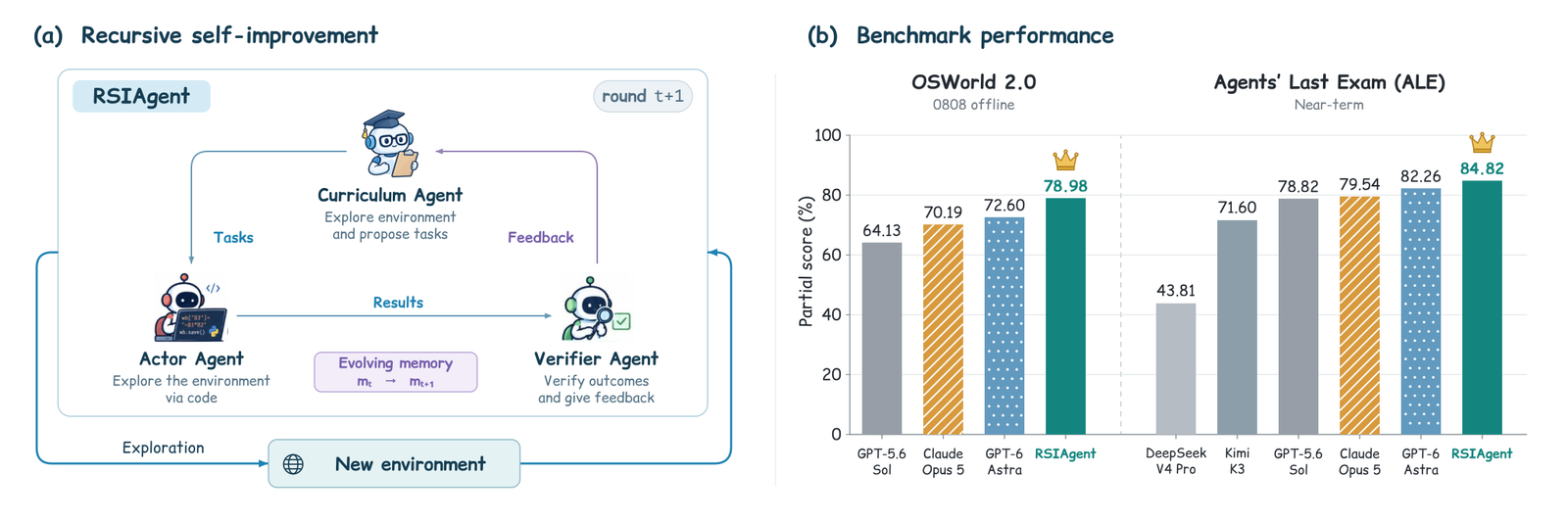
The loop is a day spent in a new application. The pretrained model has seen software in training. It has not spent that day in this copy of Shotcut or REAPER. RSIAgent is a way to spend it: pick exercises, try them on the machine, check what the machine actually did, write down what held, then stop writing and use the notes.
In the reported configuration, GLM-5.3 is the actor. Kimi-K3 is the verifier and the curriculum agent, each in its own context. Broad exploration has a nominal budget of eight projects, up to four at a time. Deep exploration continues until the curriculum agent decides further practice is not useful. Both stages use the target query as a reference for the curriculum agent. Deep exploration attempts the target itself before the frozen evaluation.
They evaluate on OSWorld 2.0, the 8 August 2026 offline split of 82 tasks, and on Agents' Last Exam Near-term, 67 tasks. Partial score is mean task credit. Binary is the share of tasks with full credit.
Without the recursive practice, their actor and verifier setup scores 71.97 partial and 37.80 binary on OSWorld, and 83.75 partial and 49.25 binary on ALE. With practice, they report 78.98 and 42.68 on OSWorld, and 84.82 and 50.75 on ALE. They compare those partial scores with published GPT-6 Astra numbers of 72.60 on OSWorld and 82.26 on ALE, and with Claude Opus 5 at 70.19 and 79.54. On ALE binary they report 50.75 against GPT-6 Astra's 52.24. Baseline numbers for other models, they write, are mostly copied from official reports or blogs.
The appendix qualifies the aggregates. The OSWorld RSI row replaces baseline scores on 41 tasks and keeps baseline scores on the rest. The ALE row combines 19 RSI scores with 48 baseline scores. In the documented OSWorld expansion cohort, tasks already at full credit were not given extra practice. Comparison systems keep their original setups and budgets. The authors say the cross-system comparison does not use a matched evaluation protocol. Sources for the other models were accessed on 11 September 2026.
They illustrate the notebook with application-specific cases. On OSWorld T044, a Shotcut video task, the baseline cropped with generic filters. The run with memory used Shotcut's native crop, 76 pixels from the top, which the scorer accepts. On T085, a REAPER radio-bumper task, practice revised a rendering setting after two constructions disagreed, and the frozen-memory run reused that setting. The archived baseline scores 0.6800. The first frozen-memory evaluation scores 0.9417. Component credit on sentence gaps and the processed ending rose. Source-order credit did not.
They also write down how the loop fails. Practice can miss the decision that is actually wrong. The verifier can pass an output that still fails the official rubric. A locally accepted mistake can become a reusable rule. In inspected form-completion runs, they say, the actor kept rules that treated missing-data markers as valid answers, or treated unavailable information as a negative answer, and later attempts reused those rules.
They list limits of their own. Extra practice costs compute. Performance depends on budgets, stopping rules, and the quality of the notebook. The model-based verifier can be wrong, and those errors can enter later practice. The experiments do not fully isolate every component.
Curriculum, actor, and verifier feed a single notebook. Broad practice writes many lines. Deep practice adds denser ones. The notebook freezes, then a later attempt reads it. In the last beat a local PASS stamp is followed by a red line copying onto a later page, which is the failure mode they describe in section 4.6.