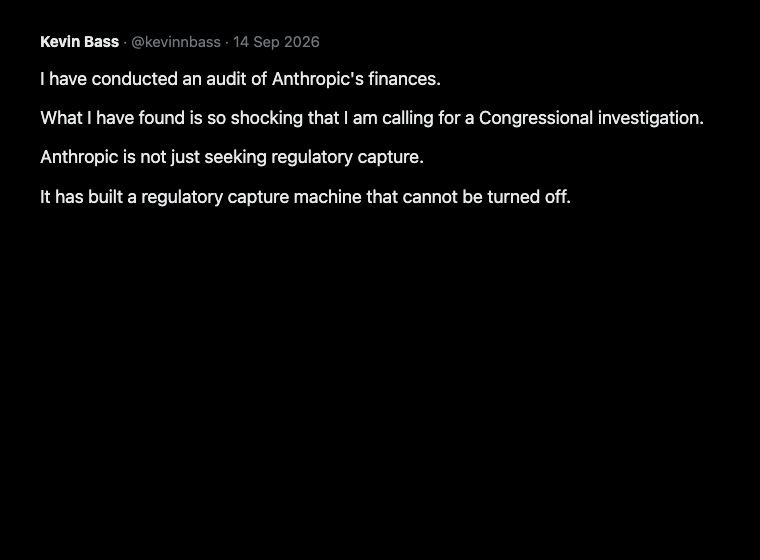
On 14 September 2026, Kevin Bass posted a long note tweet saying he had conducted an audit of Anthropic's finances. What he found is so shocking, he writes, that he is calling for a Congressional investigation. Anthropic is not just seeking regulatory capture. It has built a regulatory capture machine that cannot be turned off. Structural financial incentives, he says, make it impossible for Anthropic, which he calls the Anthropic Network, to turn off its own AI doom cycle.
It starts with METR. Dario Amodei, he writes, proposes "third-party evaluators" to assess the risk of Anthropic's models, and proposes METR for that purpose. Bass says METR is financially dependent on Anthropic's success, specifically on the explosive growth of more than $7 billion in Anthropic stock. Dustin Moskovitz invested this stock into Good Ventures Foundation, where, on Bass's account, it represents the majority of that organization's portfolio. Good Ventures is the overwhelming funder of the entire Anthropic Network ecosystem. The stock was worth $500 million early last year, he writes, and more than $7.7 billion about 16 months later.
METR, and people building careers at its parent organizations, cannot afford to disrupt that growth. If Anthropic goes under, many of the organizations that fund METR go under as well. If Anthropic succeeds, METR and its parent organizations become more richly financed to regulate AI, which he says those at METR want. The third-party evaluator is not third-party at all. "The evaluator is on Anthropic's payroll."
The same organizations that fund METR, he writes, also fund organizations such as the Tarbell Center that promote AI doom. Tarbell publishes AI doom articles in The Verge, Science, the LA Times, The Dispatch, TIME, and others. They are selling the problem and then selling the solution, from the same money pile: Anthropic's. All of these organizations are financially dependent on the same exploding $7 billion pile. As Anthropic grows more powerful, its AI doom machine grows better financed and louder. Meanwhile the regulatory regime seeded in METR grows larger to solve the increasingly loud, now hysterical, problem of AI doom that the Anthropic Network itself created.
From that standpoint, as Anthropic becomes more powerful, AI might be getting scarier, he grants, but the positive feedback loop also becomes more deafening, independent of objective facts. That loop, he writes, is itself an objective fact. The deafening doom is part of a business model: as it expands, there is simply more money to do the messaging. The problem also runs the other way. If Anthropic dies, the regulatory regime and the AI doom machine are crippled or die. Neither METR nor Tarbell nor the other organizations in the network can allow that. Hence neither METR nor the doom machine can be trusted to provide independent assessments of Anthropic's models or of AI more broadly. They are not organizations independent of Anthropic.
Anthropic cannot detach itself either, he writes, because those groups drive hype for the models and the possibility of eventual regulatory capture, and Anthropic will not give that up willingly. The people at these organizations are the same ecosystem. They shuffle between organizations. So long as it is successful, the Anthropic Network is locked into a self-amplifying feedback loop inside an ideological monoculture. That loop is winning. "That's what Jacob Coxon is."
China, he writes, is keeping messaging tight, which is why optimism for AI is so high there. America has Anthropic: a massive company pushing anti-AI propaganda at a state level. Anthropic will either create hysteria until American AI slows down and China wins, or it will create fractures throughout American society with severe political consequences. Because of the structural financial incentives, the Anthropic Network has become the same kind of self-amplifying virus that it fantasizes AI will become, while hiding its tracks just as carefully. It is the mirror of the AI virus it hypothesizes will consume America. Anthropic's business model models itself after the thing it claims to fear, except the ideology infects humans, not computers. Congress must investigate. Evidence and GitHub, he writes, are in the next post, then some supplementary figures.
The post is his argument. It does not attach the filings. He says those come next.