In October 2025, Pascual Restrepo of Yale and the National Bureau of Economic Research published working paper 34423, We Won't be Missed: Work and Growth in the AGI World, for an NBER volume on the economics of transformative AI. The NBER cover page discloses that he has been part of Anthropic's Economic Advisory Council since 9 May 2025. There are nineteen pages of model and discussion, an online appendix of proofs marked not for publication, and no data at all. A paper built entirely from assumptions and dated predictions is unusually easy to score against a year of numbers.
The model runs on two assumptions. AGI is defined as a cost: for every kind of work, the amount of compute needed to replicate it falls to some finite number, written α(ω). Compute itself is assumed finite at any moment but growing without bound. Work then splits in two. Bottleneck work is what growth cannot continue without, either because its quantity has to expand or because its price would run to infinity, and his examples include feeding and sheltering people, producing energy, maintaining infrastructure, advancing science, decision making, logistics, national security, and policing. Supplementary work is what the economy can leave fixed while still growing, and that category holds arts and crafts, literature, hospitality, design, customer support, and judicial work. He adds that academic economics may turn out to be supplementary.
Once all bottleneck work is automated, the production function stops multiplying compute and labor and starts adding them. Output settles at A times the sum of compute and the compute-equivalent of each bottleneck skill, plus a bounded term for supplementary work that stays human, where CEU(s) is the compute needed to replace a worker of skill s. Growth then equals the growth rate of compute. Wages settle at A times that compute-equivalent value, and below it for supplementary workers. The labor share of GDP converges to zero. Against that, total wages at every point in the transition are at least what they were before AGI, on the argument that a small group could always wall itself into a no-AGI zone and reproduce the old production function, so competitive equilibrium cannot leave workers collectively worse off. The paper concedes in a footnote that the argument breaks once land and energy are also scarce, since a no-AI zone would have to bid for them.
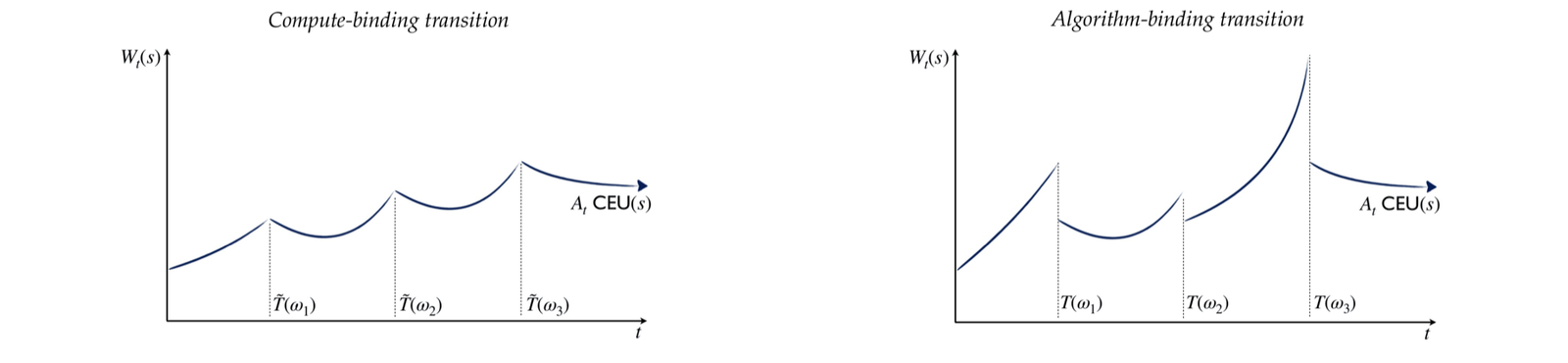
Which way the transition feels depends on what is scarce. If compute is the constraint, automation waits until machines are cheap enough and wages follow continuous paths, stepping down as each task goes and recovering as workers move. If algorithms are the constraint, tasks automate the moment they are feasible regardless of price, employment drops immediately, and wages jump. Figures 1 and 2 in the paper draw the two cases side by side.
Add science and the arithmetic changes without changing shape. With AGI doing scientific bottleneck work, the growth rate of output becomes the growth rate of compute times (1/β + 1), where β measures how much harder ideas get to find. That beats the plain compute growth rate you get from production alone, because some compute now raises the productivity of the rest, and the growth rate stays linear in compute. No explosion unless the compute supply explodes.
Compute grew. The five largest hyperscalers spent roughly $150 billion in 2023, and Goldman Sachs puts 2026 at about $800 billion, up 94 percent on 2025, with $1.2 trillion in 2027 and $1.4 trillion in 2028. Moody's has 2026 at $785 billion. A Federal Reserve study cited by Bank of America finds data center plant and equipment added about 0.20 percentage points to US GDP growth in 2025 and about 0.40 in 2026, and data centers now take nearly 46 percent of private office construction spending against under 5 percent a decade ago. The International Energy Agency expects data center electricity use to roughly double from 485 terawatt-hours in 2025 to 950 in 2030.
The labor share drifted to 52.8 percent in the second quarter of 2026, the lowest reading in a series that starts in 1947, and 52.9 percent of nominal GDP against 53.7 percent in the first quarter. Real weekly earnings were flat through the first half.
Employment for young workers moved more. The August 2026 update of the Stanford paper Canaries in the Coal Mine?, using ADP payroll records through June 2026, finds 22 to 25 year olds in AI-exposed occupations 19 percent below where they would be had they kept pace with less-exposed peers, against 15 percent at the July 2025 vintage. Experienced workers show no such gap. In levels, that age group in the two most exposed quintiles fell about 11 percent between November 2022 and June 2026 while the three least exposed grew about 10 percent. The authors trace the gap to hiring rather than separations, and to occupations where AI substitutes for a task rather than helping with it, and they note that base pay has not moved. A Census working paper reaches a similar 12 percent decline in the most exposed quintile over the ten quarters after ChatGPT. Warwick's The Broken Ladder pushes back: control for work-from-home exposure and the generative AI coefficient attenuates sharply, often to statistical indistinguishability from zero.
Capability moved on the schedule the model needs. METR's Time Horizon 1.1, released in January 2026, put the median doubling time for the length of software task a frontier agent completes at 195.8 days, with tasks running eight hours or more doubled from 14 to 31. By May 2026 the strongest assessed agents sat around 16 to 20 hours at a 50 percent success horizon, above which METR says its own measurements stop being reliable. Token prices fell about 600-fold between 2020 and early 2026, from $60 per million input tokens for GPT-3 to roughly $0.10 at the economy tier.
Governments began reserving compute. The UK put up to £2 billion to 2030 behind a public compute ecosystem and £500 million behind a Sovereign AI Unit. Canada opened an AI Sovereign Compute Infrastructure Program with about $890 million for the build layer across seven fiscal years from 2026. India subsidises GPU access at up to 40 percent, at under a dollar an hour. Per Capita's Australia's AI Dividend, published this month, recommends public equity in data center campuses, a revenue apportionment tied to registered models, reserved sovereign compute, and proceeds held in a national fund.
None of this reaches the paper's premises. No system has a finite replication cost for all economically valuable work, and METR's suite goes unreliable past 16 hours. No wage has been observed converging on its compute-equivalent. The science-driven growth bump is not visible in any aggregate.
Editorial
Judged as a forecast, the paper's dull premise held and its headline has not. Compute grew roughly as the second assumption requires. The labor share is at a record low, but 52.8 percent is not zero, and it has been falling since 2000 for reasons that long predate any language model. The transition shape is the interesting case.
Proposition 8 says an algorithm-binding transition produces discontinuous wage paths. What arrived was a discontinuous hiring path with flat wages. The Stanford numbers are explicit that adjustment ran through employment rather than base compensation, and nobody has been offered a compute-equivalent wage, because no employer prices a junior analyst against the cost of replicating her with an API.
The gap is that the model assigns each skill a single wage path, and labor markets do not trade in skills. They trade in a ladder, and automation took the bottom rung. Junior work tends to be the codified part of a profession, which is the part a model can absorb first, and the paper's own Proposition 7 puts the least computationally demanding tasks at the front of its automation queue. What it does not predict is the form the damage would take: a rung removed rather than a price cut, and a cohort that never gets on.
The supplementary category does not explain who was spared. Restrepo's refuge is work the economy does not need in order to grow, like hospitality and live performance. What stayed human in the data was senior work inside bottleneck occupations. The Stanford authors locate the split in codified versus tacit knowledge within a single occupation, which means a 22-year-old and a 45-year-old can share a job title and sit on opposite sides of the same line.
"In the AGI world, we would not be missed" describes a world where human skill no longer raises living standards, and nothing in the last year shows that. What the year does show is narrower, and it is already visible in the payroll records: the cost of starting went up.
He suggests in the discussion that compute be treated as a public resource, akin to land or natural capital, with its returns distributed broadly. The UK, Canada, and India have since published public compute programmes, and all three are about supply: capacity held for the state, capacity for researchers, or a subsidy that lowers the price of access. Distribution itself turns up only in the Per Capita report, as a recommendation.