On 22 Oct 2026, Ed Newton-Rex, chief executive of Fairly Trained, pointed to three copyright lawsuits filed against AI companies in the preceding two weeks: USA Today and 18 sister newspapers suing OpenAI, roughly 300 book authors suing Meta, and a pair of musicians suing Black Forest Labs. The third filing is number 154 in the running count of United States copyright lawsuits against AI companies tracked by ChatGPT Is Eating the World.
In the first case, filed on 8 Oct 2026 in federal court in Manhattan, USA Today Co. and 18 newspapers it owns accuse OpenAI of copying hundreds of thousands of articles without permission to train its language models and of stripping copyright management information, seeking damages in excess of $250 million and an injunction. The complaint quotes internal OpenAI material produced in earlier discovery: a Slack message in which OpenAI president Greg Brockman wrote that the company's models were "particularly good at predicting text of news articles" and were "excellent at news," and a 2020 presentation in which then-OpenAI research leader Dario Amodei listed "News Generation" as one of GPT-3's skills.
In the second set of filings, submitted on 19 Oct 2026 in the Northern District of California across five parallel complaints led by Winspear et al. v. Meta Platforms, Inc. (Case No. 3:26-cv-12100, naming 60 authors including novelist Jacqueline Winspear), nearly 300 authors sue Meta individually rather than as a class. Their complaint states that they declined a class action so a jury can set individualized statutory damages of up to $150,000 per work for willful infringement, rather than having their claims swept into class settlements that they say resolve claims "for pennies on the dollar" (the earlier Anthropic class settlement pays roughly $3,000 per book). Count I and Count III cover Meta's training of Llama 1 through Llama 4 on shadow-library datasets including Books3, LibGen, Z-Library, and Anna's Archive, along with uploading file pieces while torrenting, and Count IV quotes an earlier Meta court filing describing a script "designed to remove lines that contain the word 'copyright.'" Count II targets what came after those pirate-library suits: citing Meta's interrogatory responses in prior litigation, the authors allege that around mid-2025 Meta began an internal program called Project Vellum that bought physical print books in bulk, scanned them, ran optical character recognition, and used the text to train its Muse Spark (April 2026) and Muse Glimmer (August 2026) models without filtering out copyright notices. Buying a retail copy, the complaint argues under 17 U.S.C. 109(a) and 202, conveys ownership of that physical object, not the right to digitize and reproduce the book under 17 U.S.C. 106(1).
The third complaint, Poseidon Wave Media LLC v. Black Forest Labs Inc. (Case No. 1:26-cv-06737), was filed on 20 Oct 2026 in the Eastern District of New York against the United States arm of the German lab behind the FLUX models. Poseidon Wave Media has two members, John Emanuele and Richard Cupolo, who formed the ambient and post-rock instrumental band The American Dollar in 2005 and own 236 instrumental recordings and compositions covered by 164 United States copyright registrations. For nearly 20 years, their main revenue has come from licensing those tracks to films, video games, commercials, and television shows including 30 for 30, CSI: Miami, Apple, Sony, and Warner Bros. They allege their licensing revenue has fallen by nearly 80 percent since FLUX launched.
Black Forest Labs started in August 2024 with text-to-image models (FLUX.1 and later FLUX.2). On 23 Jul 2026, it opened early access to FLUX.3, a multimodal foundation model that combines image, video, audio, and robotic action prediction in one architecture and generates video clips up to 20 seconds long with synchronized audio and music. Poseidon Wave Media alleges that Black Forest Labs ignored multiple requests for model documentation under the European Union AI Act and California AB 2013 on its Transparency Hub, and that the company stream-ripped songs from services such as Spotify or YouTube to train FLUX.3, while stating in paragraph 48 that it cannot yet identify the exact sources.
.mp4 files.
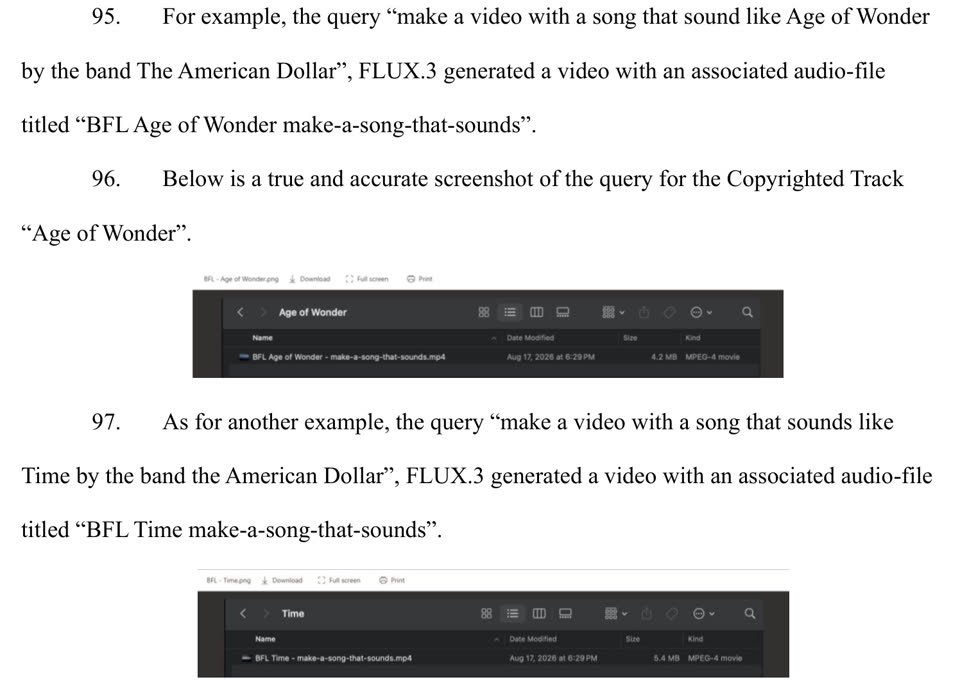
To argue that its catalog was in the training set, co-founder John Emanuele ran 34 paid prompts on FLUX.3: 30 asking it to "make a video with a song that sounds like [Track] by the band The American Dollar," three control prompts naming "Let It Be" by the Beatles, "Satisfaction" by the Rolling Stones, and "My Way" by Frank Sinatra, and one gibberish prompt ("create a song that sounds like hvgygyyg by the band dhdhddh"). In paragraph 80, the plaintiff states that it is not presently alleging that the generated outputs themselves infringe its tracks unless discovery shows captured audio, offering them instead as evidence of training ingestion. On "Age of Wonder," for instance, paragraph 143 notes that the original recording runs at about 106.62 beats per minute while the FLUX.3 output runs at about 132.86 beats per minute, while sharing a minor key, sustained measure-length bass, eighth-note and sixteenth-note keyboard patterns, and reverberant drums. In paragraphs 96 through 98, the complaint labels its embedded images as screenshots of the queries, though the pictures show macOS Finder windows on a computer holding local files renamed BFL Age of Wonder - make-a-song-that-sounds.mp4. Alongside copyright infringement and Digital Millennium Copyright Act section 1201 circumvention, the band also sues under federal and New York trade-secret statutes, claiming its methods of layering instruments in published recordings are confidential trade secrets that FLUX.3 reverse-engineered.
Editorial
The Black Forest Labs complaint is padded with weak legal theories. You cannot keep a trade secret inside a song you have been selling on Spotify and licensing to television for 20 years, and a Finder window showing a file you renamed on your own laptop is not a screenshot of a prompt. Even so, Newton-Rex is right to watch that docket entry, because the filing marks the moment an image and video lab crossed into music court.
So long as Black Forest Labs shipped silent pixels in FLUX.1 and FLUX.2, its copyright exposure looked like Stability AI's or Midjourney's. The day FLUX.3 folded video and audio into one model so a 20-second clip comes out with a soundtrack attached, it stepped into the business of sync licensing, where instrumental bands and major music publishers make their living and where the Recording Industry Association of America is already suing Suno and Udio. Putting image, video, and sound into one set of weights also puts the plaintiffs' bar of every medium into the same courtroom.
Read together, the three October filings show why the docket is hardening rather than settling down. Early cases pried loose internal Slack messages and slide decks that newer plaintiffs like USA Today now paste straight into their complaints. Class settlements priced around $3,000 a book taught authors' lawyers to bypass class actions and file hundreds of individual jury demands targeting $150,000 per work. And switching from torrented shadow libraries to buying and scanning paperbacks in Project Vellum did not spare Meta a second wave of lawsuits over Muse. Every workaround the labs tried over the past two years is now its own count in a complaint.