In June 2019, four researchers at MIT Lincoln Laboratory published a fifty-six page review in Applied Physics Reviews titled Trapped-Ion Quantum Computing: Progress and Challenges. Colin Bruzewicz, John Chiaverini, Robert McConnell, and Jeremy Sage had no product to sell, which is why the document spends most of its length on what physically stops you rather than on milestones. It remains the most useful account of the modality I know of.
Section IV sets out three routes to a larger machine. One is a longer linear chain of ions. One is a two-dimensional array built on the quantum charge-coupled device, where modules hold a few ions each and the ions are physically shuttled through X-junctions into an interaction region, gated there, and shuttled back. The third is photonic interconnects, linking separate modules with entanglement distributed by photons. Figure 8 draws all three.
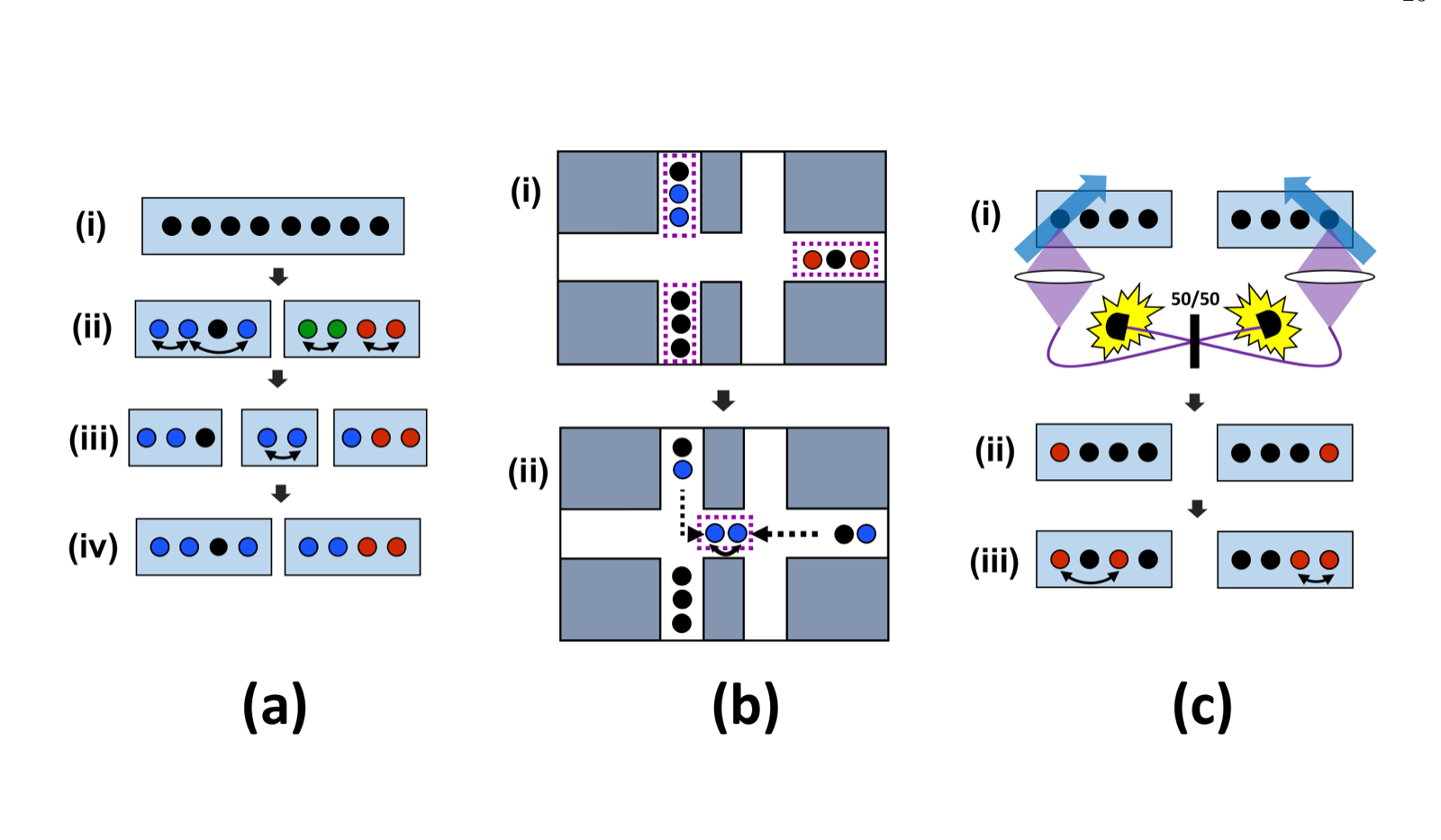
The review also recorded where the physics stood. Single-qubit rotations had reached 99.9999 percent fidelity, which it notes beat every other modality. Two-qubit entangling gates had reached 99.9 percent for hyperfine qubits and 99.6 percent for optical qubits, the best of them a geometric-phase gate running in 100 microseconds. State preparation and readout had managed better than 99.99 percent in under 200 microseconds, and 99.93 percent in 11 microseconds. Chains of more than fifty ions had been controlled.
On error correction it was careful and, as it turns out, consequential. A logical qubit can be encoded in as few as five physical qubits in principle, but real codes cost far more, and the surface code has a threshold of roughly one percent. The overhead needed to reach a given logical error rate depends steeply on the physical error rate, so a modality that starts with better physical fidelity needs fewer physical qubits per logical one. Reducing physical errors, the authors write, leads directly to a reduction in required resources.
Quantinuum's Helios, published in Nature in June 2026 and on arXiv the previous November, is the second of those three routes, built. It holds 98 qubits of 137Ba+ in a two-dimensional surface-electrode trap. A rotatable ion storage ring connects two quantum operation regions through an X-junction, which is what gives the machine all-to-all connectivity: any qubit can reach any other by being moved there. Memory is divided into ring storage, which behaves like random access memory, leg storage, which behaves like a first-in-last-out stack, and a small cache holding the next batch of pre-sorted ions. The logic region gates up to sixteen qubits at a time across eight operation zones, with lasers shared between zones and running about 65 micrometres above the chip.
Its measured numbers, averaged over every operational zone rather than quoted from the best pair on the device, are infidelities of 2.5(1) × 10-5 for single-qubit gates, 7.9(2) × 10-4 for two-qubit gates, and 3.3(5) × 10-4 for state preparation and measurement. In fidelities that reads as 99.9975 percent, 99.921 percent, and 99.967 percent. The authors report that random circuit sampling on the machine runs beyond the reach of classical simulation, and they note that none of those three error rates is at a fundamental limit.
The same hardware has since been used for error correction. In September 2026 Quantinuum reported a logical memory and computation result using a code that spends about 10 physical qubits per logical qubit. In October 2026 it reported a distance-7 colour code reaching 99.9995 percent logical fidelity, at a cost of up to 37 physical qubits per logical qubit. For comparison, the first quantum charge-coupled device computer, demonstrated five years earlier, held six qubits.
One detail in the review reads differently now. It discusses 133Ba+, a radioactive isotope with a 10.5-year half-life, as a promising hyperfine candidate, and gives the reason: barium's optical transitions sit at favourable wavelengths, and its small nuclear spin helps readout. Helios uses 137Ba+, the stable isotope, and the paper credits visible-wavelength operation with allowing lasers that are more mature, more reliable, and cheaper. The wavelength argument held. The specific isotope did not.
What has not changed is the list of things that make the work hard. Anomalous motional heating still scales roughly as the inverse fourth power of the ion-to-electrode distance and still has no settled explanation. Shuttling an ion still heats its motion, so every transport operation spends part of the error budget. Photonic interconnects between modules remain a laboratory technique rather than a commercial architecture.
Editorial
Put the two fidelity tables side by side and the field looks stalled. Best two-qubit fidelity in 2019 was 99.9 percent. The 2026 system average is 99.921 percent. Best single-qubit fidelity in 2019 was 99.9999 percent; the 2026 system average is 99.9975 percent, which is worse. Seven years on, on those two numbers, the machine that shipped is roughly where the laboratory was.
The numbers do not measure the same thing. The 2019 figures are records: the best pair of ions anyone had managed, in one apparatus, under conditions arranged to favour that pair. The 2026 figures are averages across all eight zones of a 98-qubit machine that physically moves ions between memory and logic for every gate. The number held still because the object underneath it got much harder to hold still. A gate on a stationary pair in a clean trap is a physics result. A gate on whichever pair the compiler happened to route through a junction is a manufacturing result.
It is a trap that repeats across hardware roadmaps. When an artifact graduates from demonstration to product, the benchmark tightens from peak to fleet average, and the two figures cannot be compared across that boundary. The people running the machines know this, which is why the Helios paper states plainly that its numbers are zone-averaged and that none of the errors sits at a fundamental limit. That caveat rarely survives the journey into a headline.
The part of the review that deserves more credit is the error-correction argument. It says overhead scales steeply with physical error rate, so low physical error buys a cheaper code. Quantinuum ran a distance-7 colour code at 98 physical qubits, reporting five errors per million logical operations at 37 physical qubits per logical one. Had the physical error rate been an order of magnitude worse, the same code would have needed thousands of physical qubits to reach that logical rate, and nobody deploys a thousand-qubit machine to demonstrate one logical qubit. The threshold argument explains why error correction could be attempted at a hundred qubits rather than a thousand.
It also indicates where the next bottleneck sits. Thirty-seven physical qubits for one logical qubit is the top of Quantinuum's published range for the colour code behind the 99.9995 percent result, and a few thousand logical qubits at that overhead puts the total in six figures. That moves the constraint out of atomic physics and into fabrication, wiring density, laser delivery and transport speed. Shuttling is what buys the all-to-all connectivity, and it is also what caps the clock rate, since qubits spend part of every circuit travelling between memory and logic.
The one thing the review could not see is which application would matter at a hundred qubits. Its outlook puts quantum emulation first and quantum sensing second, on the assumption that a hundred-qubit machine would have no full scheme for error correction. The work that turned out to be interesting at that scale was correcting errors. In that sense the review supplied the threshold argument that made early correction practical while expecting correction to arrive much later, and both halves of that are in the same document.