Philip Krantz and five colleagues published A Quantum Engineer's Guide to Superconducting Qubits in Applied Physics Reviews in 2019, and kept revising it on arXiv until July 2021. The authors are split between MIT's Research Laboratory of Electronics, Chalmers in Gothenburg, and Lincoln Laboratory, and William Oliver holds the MIT and Lincoln appointments. The document runs to sixty-seven pages. Its title is literal: this is written for people who have to build the thing.
A parallel LC oscillator is a harmonic ladder, and a harmonic ladder is useless as a qubit because you cannot address one rung without touching its neighbours. Add a Josephson junction and the ladder bends. The spacing between the ground state and the first excited state stops matching the spacing above it, and that difference, the anharmonicity, is what lets a microwave pulse talk to one transition only.
From there the guide walks the parameter space, and its Figure 2 puts four options side by side: the symmetric transmon, the asymmetric transmon, the capacitively shunted flux qubit, and the capacitively shunted fluxonium. Each is a circuit with a tuning curve showing how its transition frequency responds to magnetic flux, and each buys something at a cost. A split transmon tunes, and tuning brings flux noise. Fluxonium has far more anharmonicity, and its frequency moves about much more with flux.
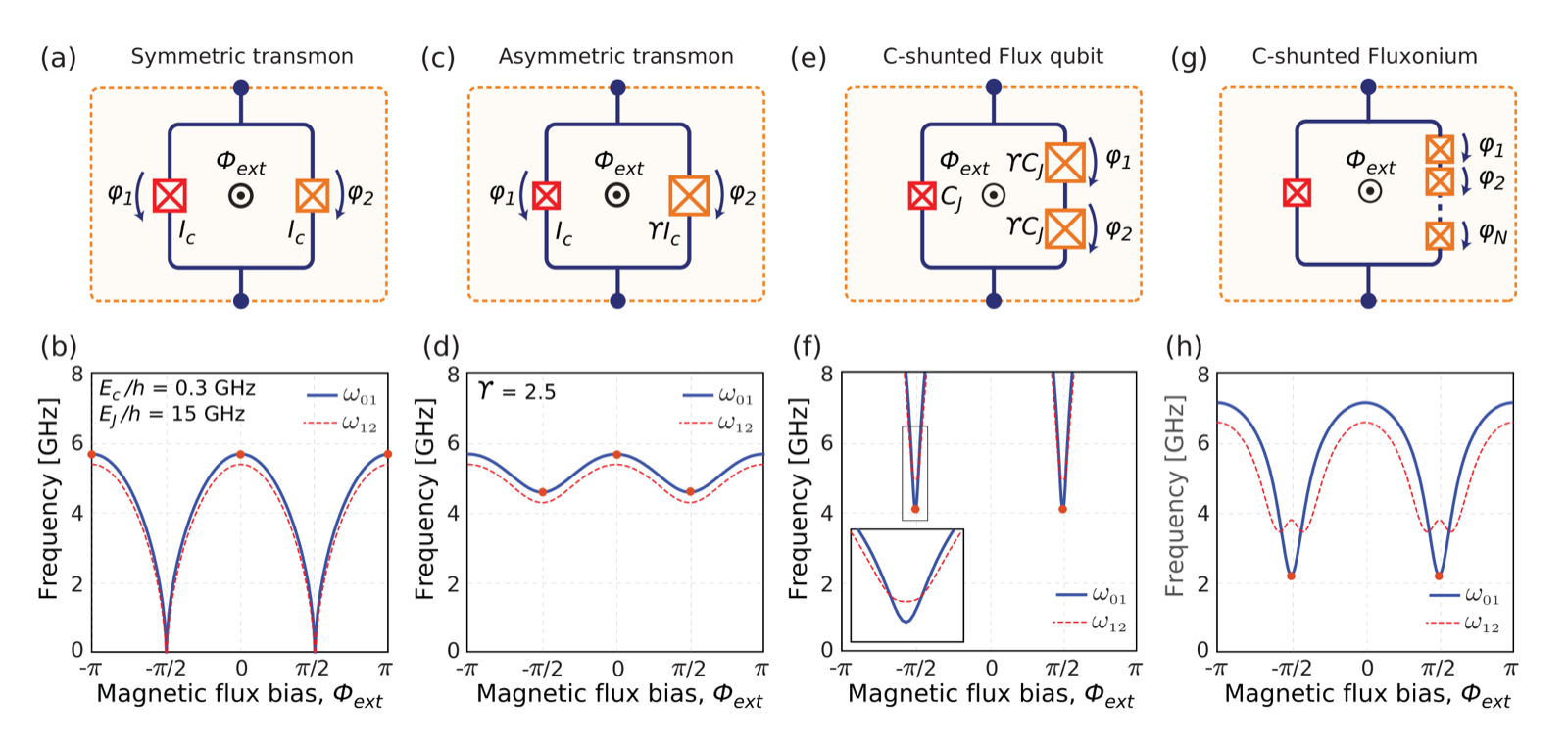
The noise section covers the Bloch-Redfield model, what 1/f spectra do to a coherence time that a simple exponential does not describe, and then the four sources an experimentalist actually fights: charge noise, flux noise, fluctuations in the photon number of the readout resonator, and quasiparticles breaking Cooper pairs. Mitigation gets its own treatment, from materials and fabrication through design changes, dynamical decoupling, and cryogenic engineering.
Control follows the same pattern of choices. Single-qubit rotations come from a capacitively coupled microwave drive, with a virtual Z implemented as a phase shift in software and DRAG shaping used to keep the pulse from leaking into the second excited state. Entangling gates get three families: iSWAP and CPHASE on tunable qubits, cross-resonance gates on fixed-frequency qubits, and tunable couplers that switch the interaction on and off. The guide presents these as options with different trade-offs rather than a ranking.
Readout is treated as a signal-processing problem. A dispersive measurement shifts the resonator frequency by an amount that depends on the qubit state, and the job is to resolve that shift before the photon leaks out and the qubit dephases. That means homodyne or heterodyne demodulation, a Purcell filter to keep the qubit from radiating into the readout line, and a parametric amplifier at the front end so the signal reaches the digitizer above the noise floor. Each addition buys signal-to-noise, and the cost lands in bandwidth or hardware elsewhere in the chain.
Near the end, the summary and outlook stops describing trade-offs and starts predicting. Quantum annealing built on flux qubits has passed two thousand qubits at D-Wave. Cavity-based approaches using cat states need relatively little hardware to encode a logical qubit. Three-dimensional integration, multilayer packages, and superconducting interconnects mean that "some of the immediate concerns for how to scale the number of qubits in the superconducting modality, have been addressed." And the guide states plainly that "the demonstration of a logical qubit with greater lifetime than the underlying physical qubits, remains an outstanding challenge," and it flags magic state distillation and injection into a surface code logical state as still open.
Google's Willow met that challenge. A distance-7 surface code on a 105-qubit chip, published in Nature in February 2025 after appearing online in December 2024, suppressed the logical error rate by a factor of 2.14 for every increase of two in code distance, reaching 0.143 percent error per cycle across a 101-qubit code. The logical memory outlived the best physical qubit on the chip by a factor of 2.4. The same work ran a real-time decoder averaging 63 microseconds of latency across a million cycles.
Three-dimensional integration has also arrived, in a form close to what the guide describes. A 2026 result stacks two qubit chips on opposite faces of a carrier chip and connects them with multilayer flip-chip bonds, with planar tunable couplers inside each chip and vertical couplers through the carrier. Single-qubit gates reach 99.87 percent simultaneously across the module and a four-qubit entangled state is generated coherently. The controlled-Z gates measure 97.5 percent, and they measure 97.5 percent on both sides of the bond.
More qubits also means more coax, and coax means heat load and no room in the fridge. A 2026 experiment makes that its stated motivation and replaces the cable with fibre, modulating microwave signals onto laser light at room temperature and regenerating them on a cryogenic plate, with 99.915 percent single-qubit and 99.676 percent two-qubit gates through the link.
A two-qubit device reaches 99.93 percent on a controlled-Z gate averaged over forty hours, with 99.98 percent simultaneous single-qubit gates and readout above 99.94 percent. It is two transmons and a tunable coupler, published in PRX Quantum in May 2026.
Editorial
Read seven years on, the guide is mostly a list of what each design choice costs. Add anharmonicity and coherence tends to fall; couple qubits more strongly and crosstalk tends to rise. Readout is the clearest case, since a faster measurement means more Purcell loss unless something filters the line.
In the outlook, three-dimensional integration is listed as a demonstrated enabling technology, and from that the authors conclude that some of the immediate scaling concerns have been addressed. Vertical couplers do now carry entanglement between chips, so the premise is sound.
A 2026 module built this way delivers 97.5 percent two-qubit gates. A two-qubit device in PRX Quantum reports 99.93 percent. That is two and a half points, which at these error rates is a factor of about thirty-five between the two error probabilities, more than measurement conventions usually account for.
Three-dimensional integration and superconducting interconnects were demonstrated, which is the claim the guide makes. That establishes the parts can be built. The scaling sentence reads it as establishing that they can be built at scale, and 97.5 percent is not what that sentence implies.
One prediction stands out because it was stated plainly and then tested. The guide says a logical qubit outliving its physical qubits remains outstanding. Willow met that in December 2024, with the logical memory lasting 2.4 times longer than the best physical qubit on the chip, five and a half years after the review appeared.