Editor's note: This is an English translation and adaptation of Who Is Buying Chips for China's Tech Giants? by Sleepy (@sleepy0x13) for Beating (@BeatingOfficial), with the five Chinese-language charts replaced by English equivalents.

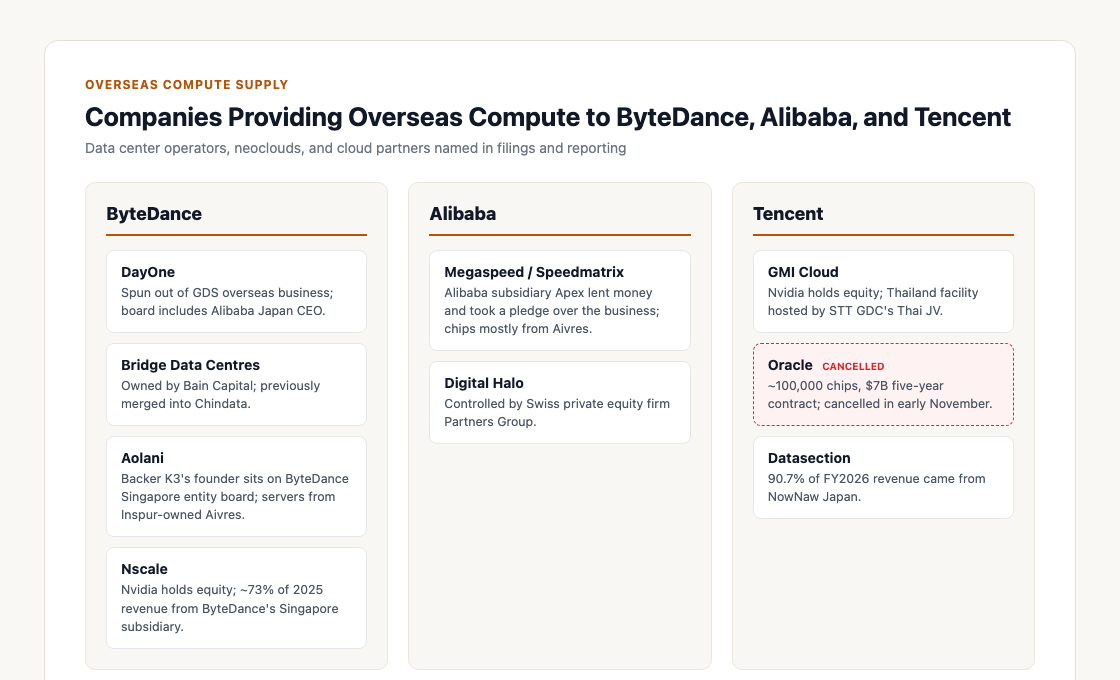
Several data center financings in Southeast Asia have run into trouble. Bridge Data Centres is expanding a loan in Malaysia to $6.6 billion, and some lenders are demanding additional due diligence first. Bridge is owned by Bain Capital, and the anchor tenant at its MY06 campus in Johor is ByteDance. Digital Halo has a $372 million loan that was already fully underwritten, yet one bank still pulled out; its controlling shareholder is Swiss private equity firm Partners Group, and Alibaba is among the customers at its Malaysia facility. GMI Cloud is seeking to borrow $300 million to buy chips for a data center in Thailand destined for Tencent, and even though Nvidia invested in GMI in October, at least one fund chose not to participate. A week earlier, a $480 million loan led by DBS Bank for Singapore-based Aolani to buy 97 racks of GB300 servers in Kuala Lumpur for ByteDance was frozen.
None of the four borrowers is a Chinese company. The facilities belong to US and Swiss private equity firms, the chips sit on the books of Singaporean and Taiwanese companies, and the money comes from Wall Street and Singaporean banks. For the past three years, this was the standard playbook for Chinese tech giants using Nvidia chips overseas: a non-Chinese company borrows the money, buys the chips, builds the facility, and leases compute by the hour under a multi-year contract. Previously, US export rules checked who bought the chips rather than who rented them remotely. On November 16, the US Commerce Department shifted the test to where the end user is headquartered. Both the front companies and their lenders began pulling back.
The companies buying the cards
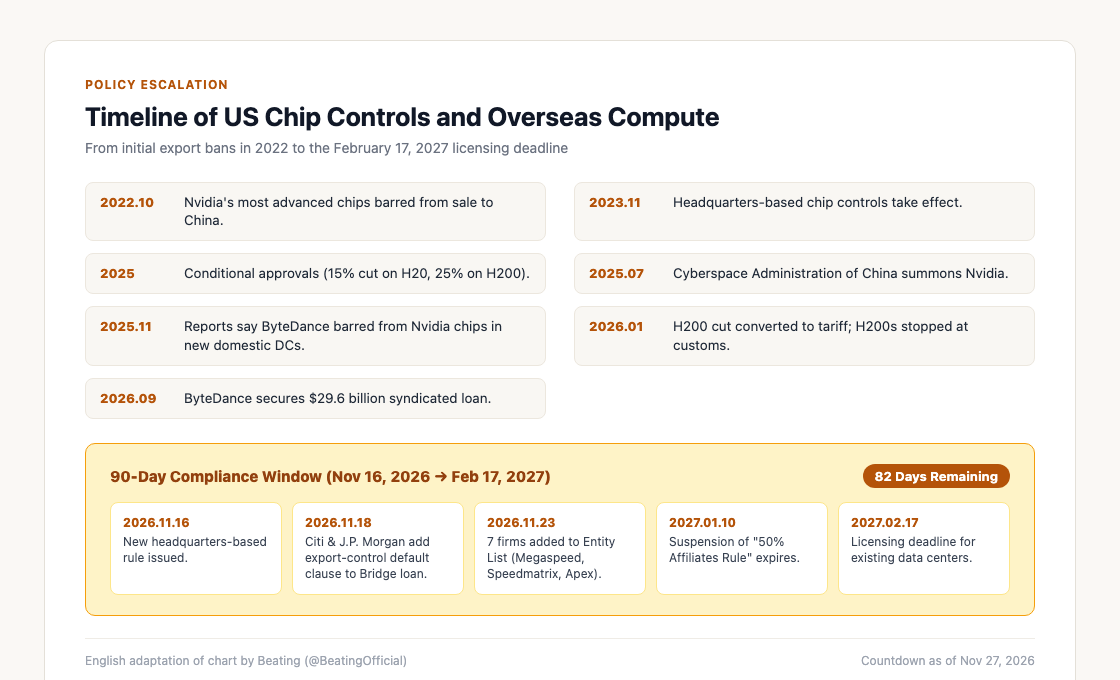
Chinese tech giants went overseas for compute because they could not get it at home. Since October 2022, Nvidia's top chips have been barred from sale to China. In 2025, the Trump administration shifted to conditional approvals with a 15 percent cut on H20s and a 25 percent cut on H200s, which became a tariff in January 2026. Yet House Foreign Affairs Committee records released on November 19 show that out of roughly 3.44 million H200 and MI325X applications as of May, only about 880,000 were approved, all marked "approved, not shipped." ByteDance applied for roughly 1.015 million and got 150,000 approved. Alibaba applied for 949,000 and got 75,000, while 1.1185 million applications through Malaysian, Indonesian, and Thai subsidiaries were all returned. Beijing blocked them too: the Cyberspace Administration of China summoned Nvidia in July 2025 over alleged H20 backdoor risks, regulators reportedly barred ByteDance from using Nvidia chips in new domestic data centers in November 2025, and roughly 600,000 H200s stopped at customs in January 2026 remain stacked in Hong Kong.
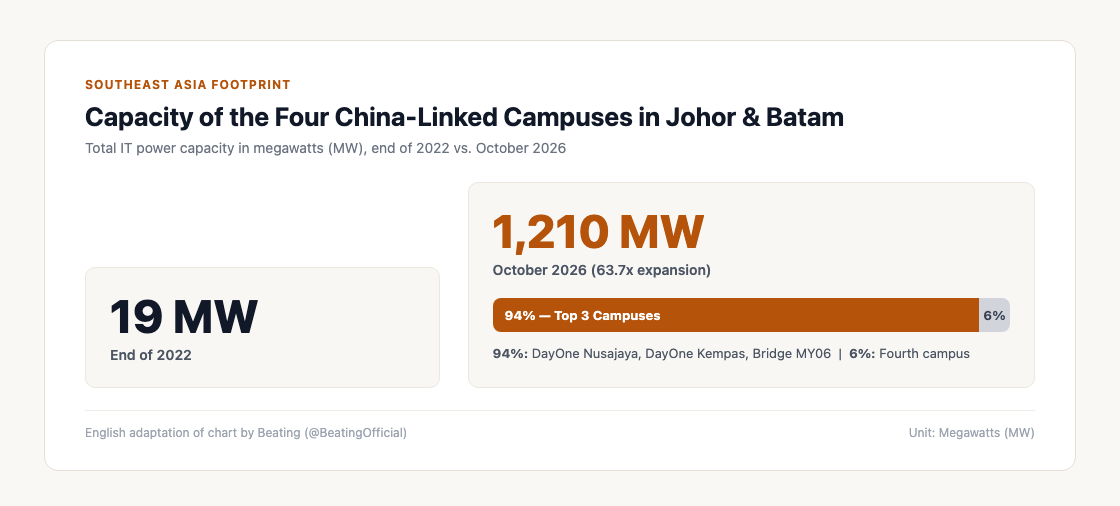
Most of the overseas capacity sits in Johor, Malaysia. Across four China-linked campuses in Johor and Batam, Indonesia, total capacity grew from 19 MW at the end of 2022 to 1,210 MW in October 2026, with roughly 94 percent concentrated in three campuses: DayOne's Nusajaya and Kempas, and Bridge's MY06.
The intermediaries fall into two groups: data center operators like Bridge and DayOne, and neoclouds that buy chips directly. On the operator side, Bain Capital merged Bridge into Chindata in 2019, took Chindata private in 2023, sold the China business for roughly $4 billion, and kept the overseas arm. In February 2026, Bridge reassigned 68.4 MW reserved for Megaspeed to Los Angeles-based Zenlayer. Zenlayer's founder previously served as SVP at ChinaCache, and its Series B backer Forebright Capital spun out of state-owned China Everbright.
The second major operator, DayOne, spun out of GDS Holdings' overseas business. GDS gradually stepped back, dropping to 19.4 percent after a $385 million share buyback in January 2026. That left Coatue and Hillhouse as the largest holders at 19.5 percent each, followed by GDS at 19.4 percent. Hillhouse has been in since Series A, and its current shares are pledged to lenders. Taipei-based Zhongfang Capital, controlled by Wang Yung-ching's eldest grandson Charles Chen, holds 15.6 percent. On the board, GDS founder William Huang sits alongside Alibaba Japan CEO Andy Okada. Chairman Lim Ah Doo and CEO Jamie Khoo both come out of Temasek's ST Telemedia ecosystem.
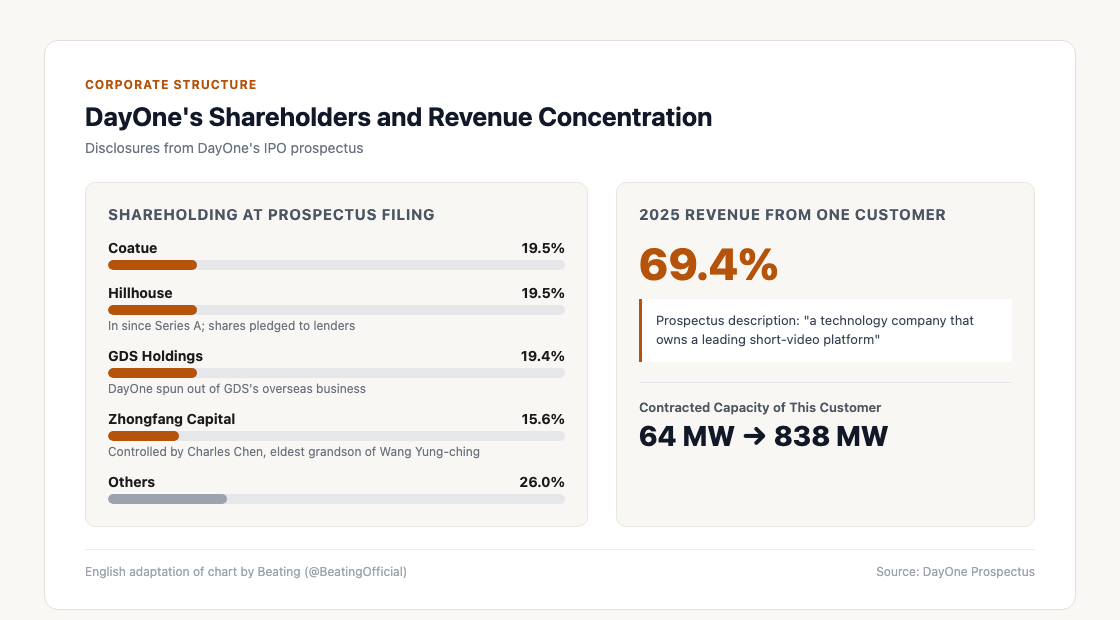
DayOne's prospectus states that 69.4 percent of 2025 revenue came from "a technology company that owns a leading short-video platform," whose contracted capacity climbed from 64 MW to 838 MW. It also notes two existing customers on the Pentagon's Chinese Military Companies list: Tencent (added in January 2025) and Alibaba (June 2026).
Beyond the data center operators, neoclouds buy chips and rent out clusters directly. The largest example in the frozen DBS loan is Cayman-registered Aolani, which rented H100s to ByteDance in Malaysia from February 2025 and prepared roughly 36,000 B200s this year. Aolani is backed by Singapore's K3 Ventures, whose founder Kuok Meng Xiong sits on ByteDance's Singapore entity board. For hardware, Aolani buys its servers from Aivres, formerly Inspur Systems. According to The New York Times, Aivres shipped at least $5.6 billion in servers to Southeast Asia between April 2024 and February 2026. Once the suspended US "50% Affiliates Rule" resumes on January 10, 2027, 100-percent Inspur-owned Aivres falls under the same Entity List controls.
Tencent and Alibaba built parallel neocloud links in Thailand and Malaysia. For Tencent, GMI Cloud is buying chips for a Thailand facility hosted by an STT GDC Thai joint venture. For Alibaba, its Singapore unit Apex lent money to Megaspeed's Malaysian affiliate Speedmatrix and took a pledge over the entire business. The New York Times linked Speedmatrix's Aivres chips to YTL's Johor data center, a claim YTL called "speculative and unfounded." Separately in Johor, Bitdeer's A201 facility ordered over 100 GB300 racks under $1.7 billion in five-year contracts. StoneX estimates those contracts now carry a 25 percent risk of falling through.
Who lent them the money
Most of these chip purchases run on debt backed by the chips and long-term tenant leases. According to Natixis, syndicated data center loans across ASEAN reached roughly $48 billion since 2023. Citigroup and J.P. Morgan appear across almost every layer. They led ByteDance's $29.6 billion unsecured loan in September 2026 at SOFR plus 68 basis points (0.68 percentage points above the benchmark overnight rate), put about $120 million each into Bridge's $2.8 billion loan last year, ran Bain's sale of at least 40 percent of Bridge in April, and sit on DayOne's IPO underwriting syndicate.
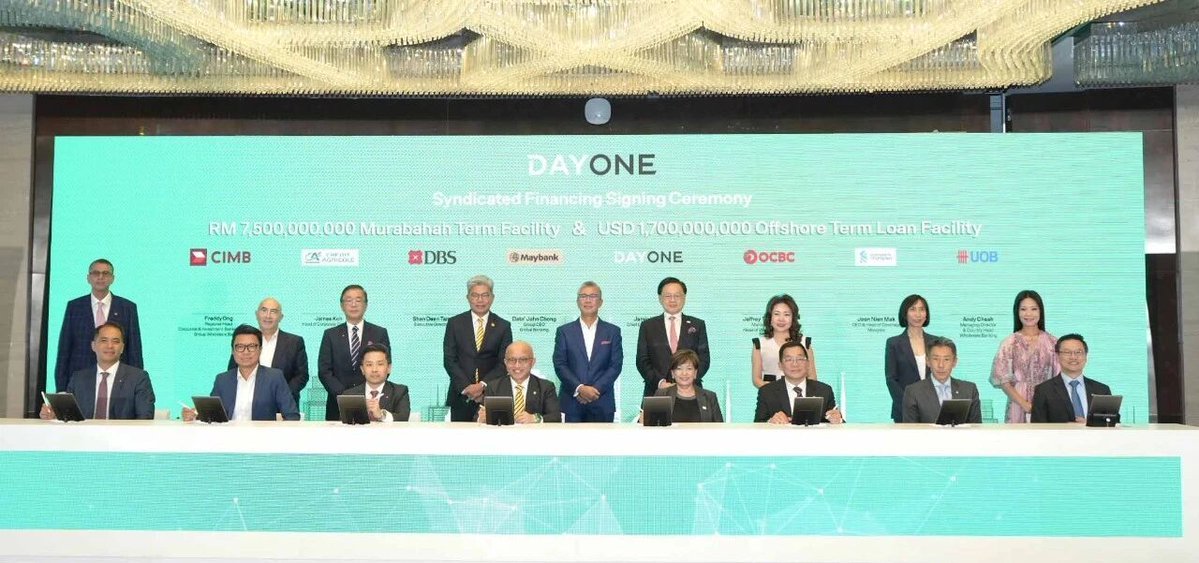
Singaporean banks handle local syndication. DBS led Aolani's loan, and all three local Singaporean banks joined DayOne's ~$3.7 billion October facility. Chinese banks put up 64 percent ($18.9 billion from 15 banks) of ByteDance's $29.6 billion loan, alongside operator deals for Bridge, Epoch Digital (BytePlus Phase 1), and a ByteDance-anchored facility in Rayong, Thailand. Nvidia has also backstopped debt for non-Chinese projects, including GMI in Taiwan and Zankore's $3.1 billion Indonesian loan, while holding equity in GMI and UK neocloud Nscale, which derived 73 percent of its $33 million 2025 revenue from ByteDance's Singapore unit Spring (projected under 20 percent this year).
What the November 16 rule changed
Under the November 16 rule, any data center anywhere in the world supplying more than 12 million TPP of compute (about 750 H100s) to a China-headquartered firm, or deriving over half its compute from Chinese customers, requires a license. Existing data centers have 90 days to comply, setting a deadline of February 17, 2027. According to Politico, Treasury Secretary Scott Bessent and Marco Rubio pushed through this stricter version over a looser draft favored by Commerce Secretary Howard Lutnick. Lutnick's family firm, Cantor Fitzgerald, served as placement and sales agent for Bitdeer, where Cantor-backed Tether holds 19.7 percent of Class A shares. One week later, on November 23, seven firms including Megaspeed, Speedmatrix, and Alibaba's Apex were added to the Entity List.
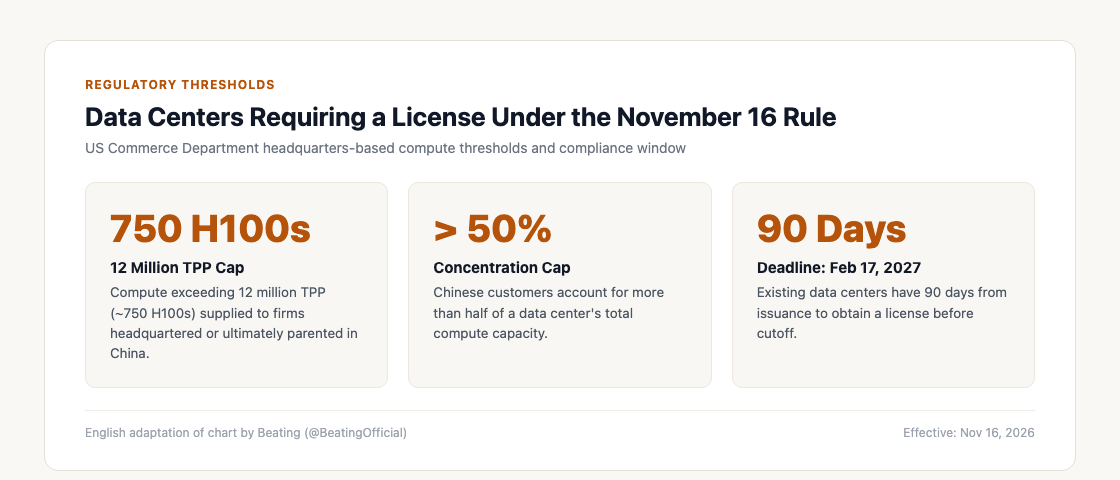
Three provisions target proxy buying directly. Prepaying rent or lending can trigger "indirect purchaser" liability. Law firm Paul Weiss notes that the Bureau of Industry and Security (BIS) treats the headquarters rule as effective retroactively from November 2023. Finally, a recommender-system carve-out skips licensing only if the data center reports Chinese customer names, usage, and due diligence to BIS.
Banks pull back first, and where the three giants stand
Although the rule grants 90 days, General Prohibition 10 of the Export Administration Regulations bars knowingly financing a restricted transaction regardless of US-person status, carrying penalties up to twice transaction value (as in Applied Materials' $252.5 million February fine). On November 18, Citi and J.P. Morgan inserted an export-control default clause into Bridge's loan, while risk-transfer capacity at HSBC, Deutsche Bank, Barclays, and UOB tightened. Credit pricing reflects the stress: ByteDance borrows directly at SOFR plus 68 basis points and GMI's Nvidia-backstopped Taiwan loan sits near 3.43 percent, whereas GMI's Thailand loan for A1/A+ rated Tencent carries teens yields and mandatory-prepayment triggers.
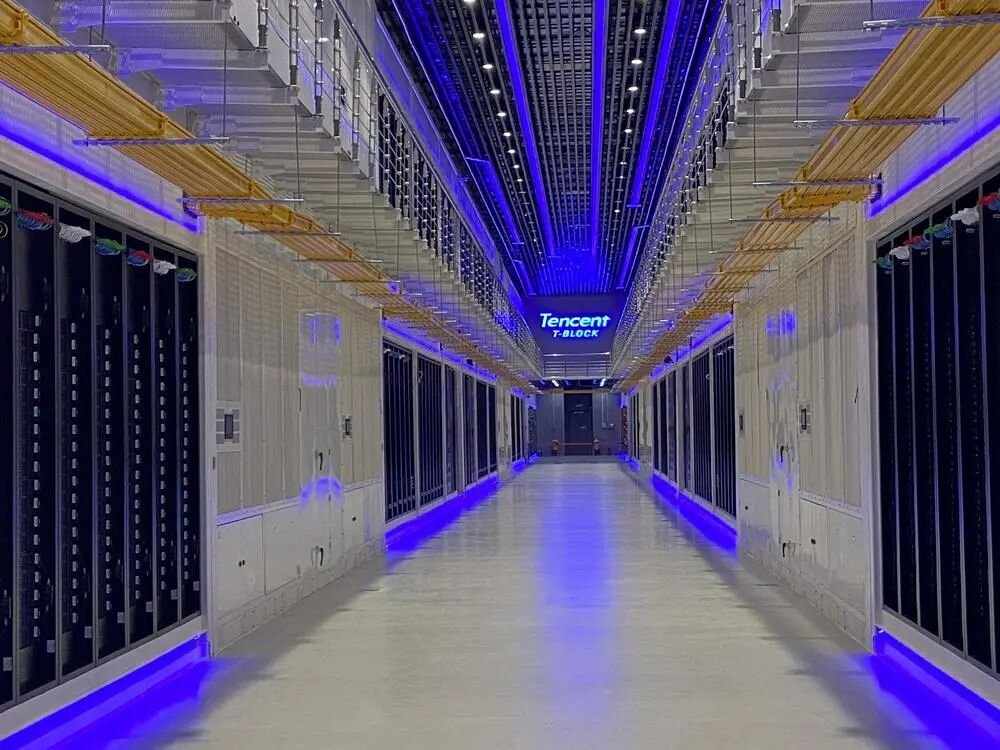
Among the three platforms, ByteDance holds the largest overseas footprint. It leases roughly 90 percent of Johor's capacity, mostly CPU for TikTok under the recommender carve-out, while its BytePlus and B200 training clusters stay exposed. ByteDance also lacks an in-house commercial AI chip after its initial design trial (tape-out) missed targets and chip lead Shi Yunfeng resigned, leaving its $29.6 billion loan (nearly two-thirds from Chinese banks) as its main cushion.
Alibaba faces direct "indirect purchaser" exposure through Apex's Entity List designation. Even so, Alibaba Cloud announced nine new overseas data centers within a year and is betting on Pingtouge's Zhenwu V900 chip, slated for mass production in Q1 2027.
Tencent absorbed the sharpest cash hit from its prepayment model. Q3 free cash flow swung to negative RMB 69.1 billion, compared with positive RMB 16.9 billion when excluding roughly RMB 86 billion in compute prepayments. Its largest partner, Oracle, cancelled a $7 billion Southeast Asia deal in early November. In Japan and Australia, Datasection derived 90.7 percent of its FY2026 revenue from NowNaw Japan. On November 16, it cut its full-year revenue guidance from JPY 162.2 billion to JPY 17.3 billion. That cut followed an August cancellation of a JPY 79.86 billion follow-on order and a Sydney landlord terminating the facility lease.
The middlemen choose sides
Cross-border intermediaries have always pivoted when geopolitical pressure peaks. Taiwan's Wang Yung-ching exited Fujian's Haicang petrochemical plan in 1992, and Abu Dhabi's G42 divested its Chinese stakes ahead of Microsoft's $1.5 billion investment in 2024. The same shift is underway in Southeast Asia now. Aolani's CEO says roughly half its contracted value comes from Western customers. Four of DayOne's top five clients are non-Asian, and Nvidia began capping Chinese customer share at 49 percent two weeks before the rule. Existing data centers must hold a license by February 17, 2027. That deadline gives middlemen room to pivot toward Western buyers, while ByteDance, Alibaba, and Tencent remain bound by where they are headquartered.

Editorial
Most coverage of US chip controls stays stuck on Nvidia shipments and customs seizures. Sleepy's reporting stands out because it follows the credit layer instead. Once General Prohibition 10 turns knowingly financing a restricted cluster into an export violation, Wall Street and Singaporean banks enforce the rule faster than any export inspector can. Insurers run out of capacity, Citi adds default clauses within 48 hours, and a $48 billion regional buildout slows to a halt.
The pricing spread and cash-flow numbers show how strained that workaround already was before November 16. An A1/A+ issuer like Tencent effectively paying teens yields with mandatory-prepayment triggers while burning RMB 86 billion in a single quarter of compute prepayments is not a sustainable structure.
Three caveats apply. Shared investors or board seats across prospectuses show proximity rather than proving operational circumvention, and YTL explicitly disputed the New York Times claim about running GPUs for Alibaba. Equally, the recommender-system carve-out gives ByteDance's CPU-heavy TikTok workloads in Johor an easier compliance path than B200 and GB300 training clusters.