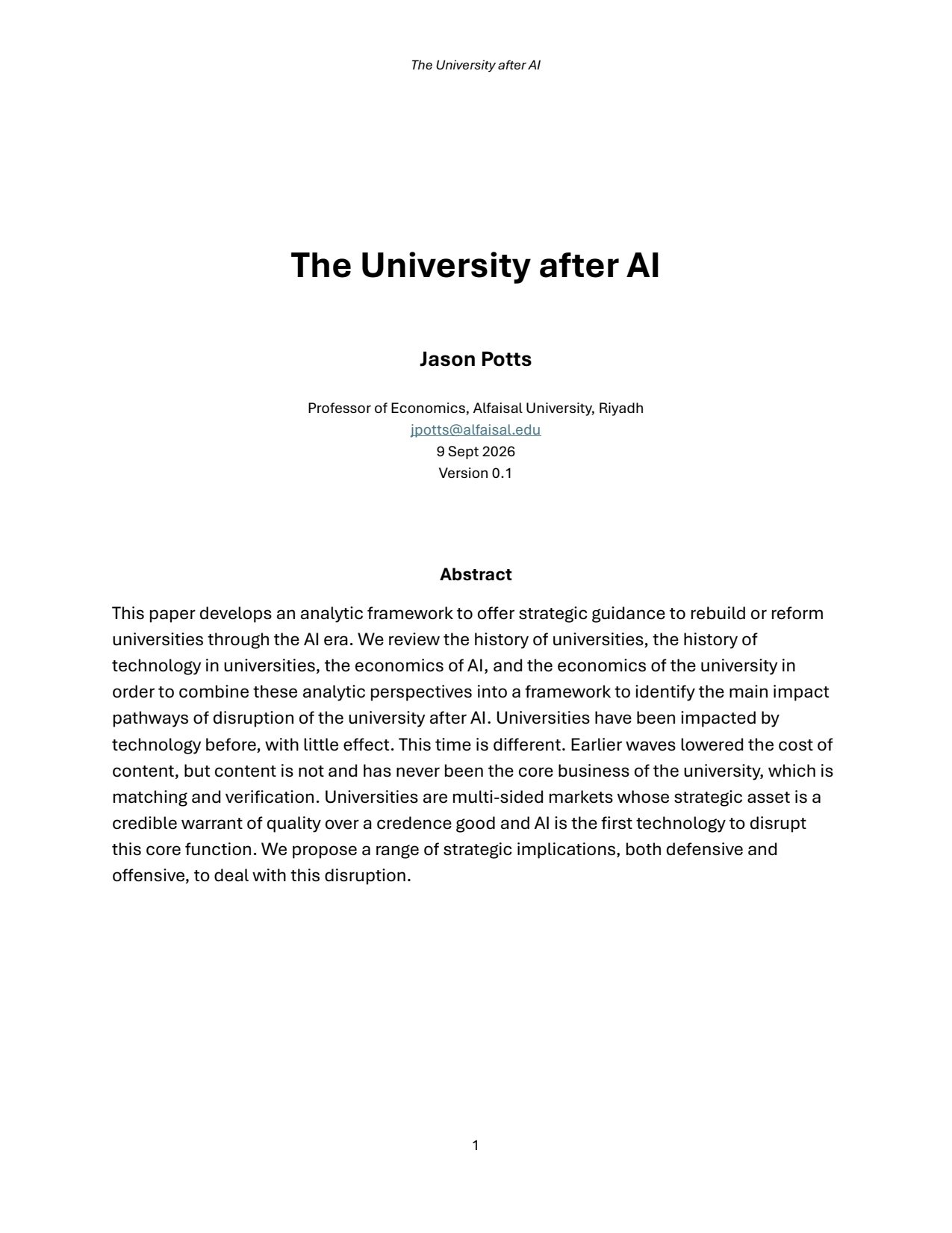
On 9 September 2026, Jason Potts, a professor of economics at Alfaisal University in Riyadh, posted a working paper titled The University after AI. It is version 0.1. A strategy memo, not a measurement.
Universities, he writes, are about a thousand years old. Books, radios, and computers all lowered the cost of educational content, and the institution stayed mostly the same. Content was never what they sold. They sell matching and verification: bringing students, scholars, employers, and funders together, and warranting to third parties the knowledge claimed. AI is the first technology to reach both functions, and so the first with the capacity to disrupt the university's business model.
He treats the university as a multi-sided market, a platform coordinating at least fifteen groups and held together by cross-subsidies among them. The product is a credence good. Nobody can see the quality directly. The strategic asset is a credible warrant over that unseen quality.
The first mechanism is signal collapse. A degree is informative, in the Spence sense, only if it costs the able student less to obtain than the less able one. AI lowers the cost of the work that gets graded (essays, problem sets, code, theses) by roughly the same amount for both, even when no rule is broken. The credential stops separating them. He points to a decline in the graduate wage premium since 2022 as consistent with this, and says there is as yet no causal identification.
The second is disintermediation. The informational sides of the platform are also the paying sides: undergraduate teaching, tutoring, literature search. A model is already a partial substitute. Research was bought with those fees. The immediate risk to research, he writes, is not that AI does the research. It is that AI removes the undergraduate teaching revenue that was buying it.
The third is that the asset most universities had to own has moved. For the ordinary university, that asset was administration, because administration was how quality assurance ran when quality could not be seen. A model can schedule an exam, mark a script, and issue a record. It cannot warrant to a third party that the person holding the record has the capability. That warrant needs an entity independent of the production, that bears reputational cost for error, and that lasts long enough for the cost to matter.
The fourth is where the rents go. Toward the capacity to adapt to new tools, and toward exploration. Away from stocks of transmitted knowledge, and away from competent execution inside settled fields.
Three things he says the technology does not touch. Co-production: education still needs the student's willingness to be changed, and cheaper output does not supply that. The peer cohort: a model cannot manufacture a cohort. Anything that needs a body or a legal person: laboratories, clinics, residences, licenses, visas.
From that he draws a set of proposals. Separate certification from instruction, and price the exam rather than the contact hours. Move assessment into a viva or another form a model cannot sit for. Occupy the junior training that firms no longer do, because the rungs where people used to learn have been automated. Stand up short credentials in new tools on a timescale of weeks.
Treat the cohort as a designed product. Host scholars rather than employ them. Specialize in the questions private AI-using science is leaving. Drop the sides that were only information transfer. Make the claim on graduate outcomes explicit. Treat collegiate governance as how a warrant is produced, not as medieval clutter. Almost no one working inside a university right now, he writes, wants the certification split.
Elite universities, whose asset is brand, are largely insulated. A specialist university whose asset is deep expertise is exposed on content and protected on standing, since expertise tied to physical or regulated practice stays scarce while purely informational expertise evaporates. It is the ordinary university, whose asset was administration, that these proposals address. A platform cannot change one side without renegotiating the rest, so the practical route is greenfield. The university has survived a thousand years mostly by founding new colleges, not by rebuilding old ones.
The paper does not show that those colleges will appear. Version 0.1 does not pretend to.
Editorial
The universities that were only selling certificates are done. When a weaker student and a stronger student can turn in the same homework at about the same cost, the certificate stops telling you who learned anything. That was the product.
The universities that still try to teach people for real will matter more. AI will take over a lot of the work humans were never that good at. School then has to spend its time on what people are good at and actually like doing, or on how to work with these systems without being run by them. Beast-tamer, if you want a name for it.
Potts would keep the exam and treat teaching as optional. An exam with no teaching is just another certificate. The useful school is the one that still changes the student.
Liking something is not the same as being hard to replace, and an oral exam only stays hard until a model can sit for that too. Those are guesses. The part that does not move is simpler. The student still has to want to be changed. We have spent too much time talking about AI, and too little on what to teach the next generation.