OpenAI says the proof was produced by an internal model significantly more capable than GPT-6 Astra.
Imagine a volume of fluid, perfectly still. You may make it as sticky as you like. After a finite time, somewhere inside that volume, the speed becomes infinite, while the total kinetic energy stays finite. The shove that drives the motion is itself smooth, and it lives only in a bounded region of space and time. That is Theorem 1.1. They say it is Clay statement (C). The same construction on a periodic box is (D).
Picture the fluid as a field of arrows, a speed and a direction at every point. Pressure shoves the arrows. Viscosity, the stickiness, tries to even them out by resisting shear between neighboring parcels. You cannot squeeze the fluid one way without stretching it another. Airplane codes and weather models already run on approximations of this. The Clay question is stricter. Can a perfectly smooth start force those arrows to become infinitely long in finite time?
In two dimensions the stickiness wins. Solutions stay smooth. In three dimensions nobody knew. In 1934 Jean Leray built a weaker kind of global solution. Whether a smooth start stays smooth was left open. Of the seven Clay problems, only the Poincaré conjecture had been settled. This paper takes the breakdown side, with a force, starting from rest, for every positive viscosity.
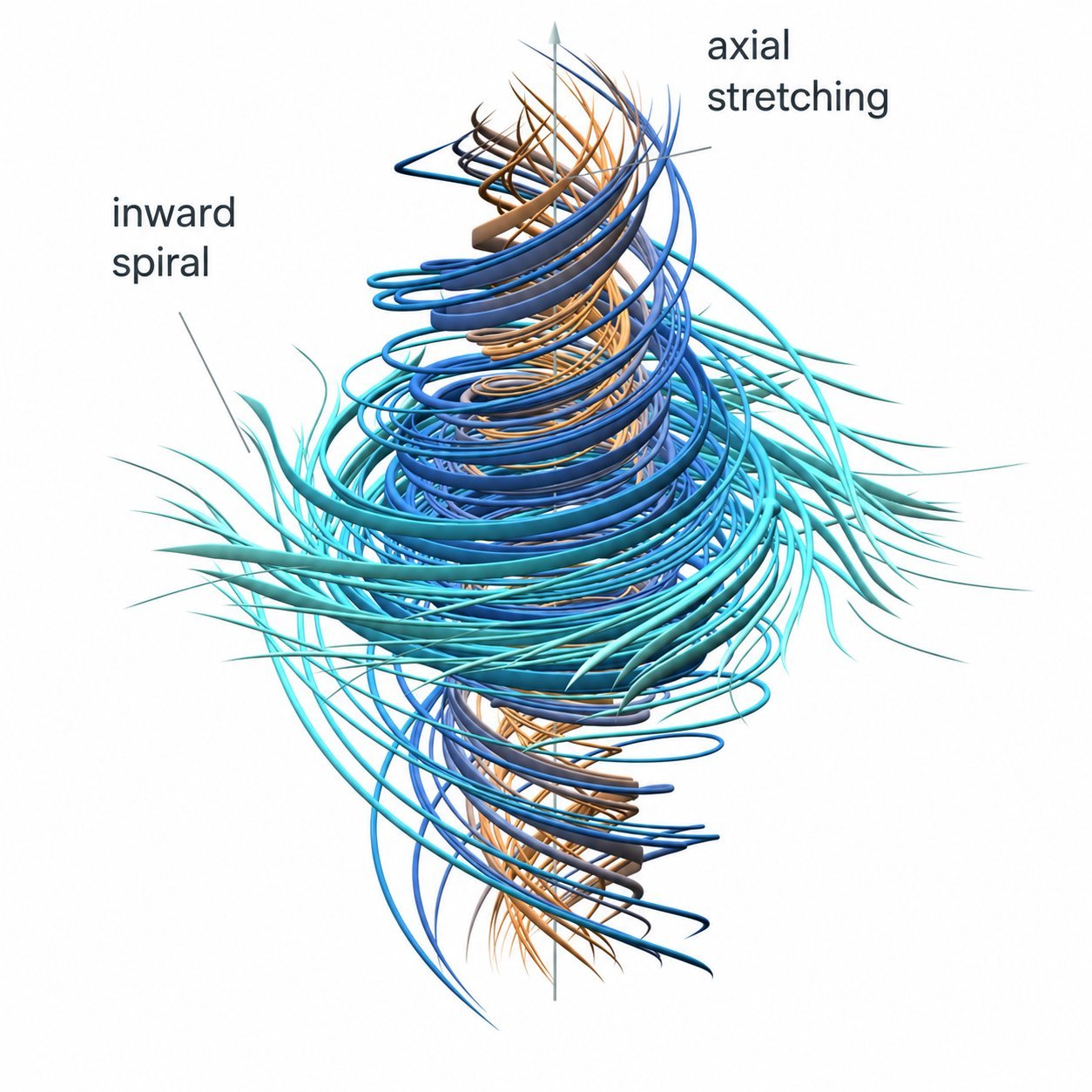
Here is the picture they draw, and it is a beautiful one. Fluid spirals inward toward an axis. Because it cannot pile up, it shoots out along the axis, up on one side of a thin dividing layer and down on the other. The core shrinks. Its radius falls faster than its height, so the swirl becomes a slender column. Speeds in that column grow. The kinetic energy of the core still tends to zero, because the region of intense flow shrinks faster than the speeds rise. Infinite speed in a vanishingly small volume can still cost only finite energy.
The force is not already infinite. You can always define the force as whatever leftover the equation has. The work is to keep that leftover smooth through the blowup, even as the separate terms diverge. They place oscillatory pulses in a ring around the core to cancel the singular leftover. Charles Fefferman's prize allows a smooth force: (A) and (B) are always-smooth with no extra force, (C) and (D) are breakdown with one. Either direction wins.
Hours before this paper, Tristan Buckmaster and Levent Alpöge posted forced blowup for incompressible porous media, Boussinesq, and 3D Euler, following work Diego Córdoba and Luis Martínez-Zoroa had opened. The writeup here is 165 pages. There is a Lean formalization. Clay has not awarded the prize.