In 2008, a 14-year-old named Taylor Wilson achieved nuclear fusion with a reactor he had started putting together in his family's garage in Reno, Nevada. After Wilson told atomic physicist Ronald Phaneuf at the University of Nevada, Reno that he wanted to build the reactor in the garage, Phaneuf gave him space in a university lab instead. Wilson built a Farnsworth-Hirsch fusor, a vacuum chamber that uses an electric field to accelerate deuterium ions toward a central grid until some collide and fuse. At 40,000 to 50,000 volts, the detector confirmed neutrons. Popular Science reported that Wilson wanted those fusion neutrons to irradiate materials for medical isotopes at low cost, rather than making them in multimillion-dollar cyclotrons. A fusor makes real fusion and real neutrons, and scientists do not consider it a viable concept for large-scale energy production.
On 21 Oct 2026, San Francisco startup Marathon Fusion posted three claims on X. First, that last month it demonstrated what it called high-rate alchemy: turning mercury into real, stable gold, beating CERN's record by a factor of 10. Second, that last week it enriched isotopes in the world's most powerful plasma centrifuge, beating a Soviet record that stood for 40 years. Third, that it is now building a fusion reactor in San Francisco to achieve record power density. The post did not include a paper, sample weight, neutron source specification, or outside measurement for the gold run, or the separation numbers behind the 40-year Soviet comparison. In the attached video, co-founder Adam Rutkowski states the gold result more narrowly, saying recent experiments showed production of rare medical isotopes and of tritium to power fusion reactors, and "validated our scalable pathway for co-production of electricity and gold."
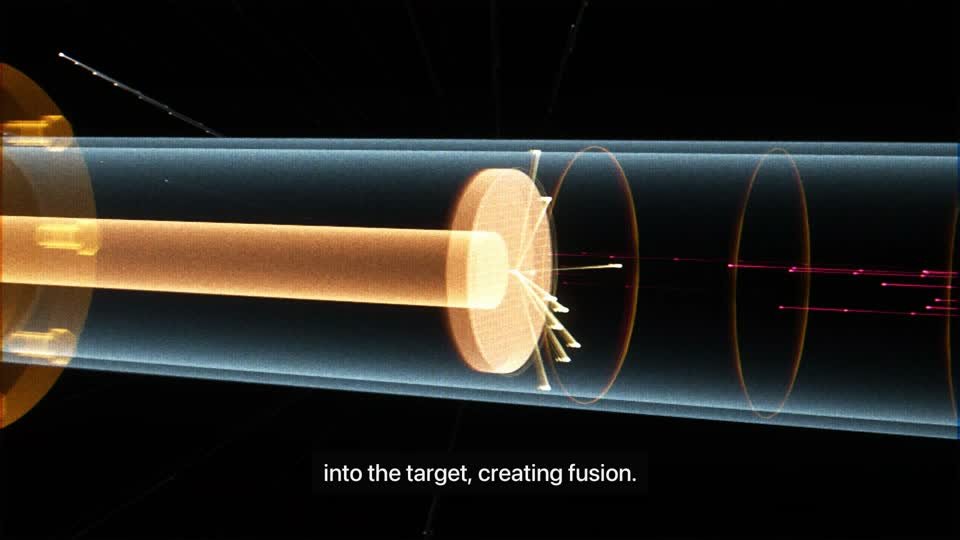
On Marathon's website and in the video, the reactor it is building at 150 Mississippi Street for first partners in 2027 is a beam-driven target machine for medical isotope production and materials qualification. It melts lithium and evaporates it onto a cooled solid plate, forms a solid layer of lithium tritide, and accelerates deuterium ions through an electric field to kiloelectronvolt energies into that target, releasing 14 megaelectronvolt neutrons. Rutkowski says in the video that scientists at Lawrence Livermore National Laboratory operated a similar reactor in the 1980s for over 25,000 hours at high fusion power density. Marathon's homepage lists the reactor at 1 kilowatt of fusion power, a power density of 20 kilowatts per square meter, and a neutron flux of 1012 neutrons per square centimeter per second. Separately, on 27 Aug 2026, the company announced via PR Newswire that it had enriched hydrogen and lithium isotopes in a plasma centrifuge supported by the US Department of Energy's ARPA-E VISION OPEN program, spinning lithium ions at over a kilometer per second to separate lithium-6 for breeding tritium fuel.
The gold pathway comes from a July 2025 arXiv preprint by Rutkowski, Jake Harter, and Jason Parisi, Scalable Chrysopoeia via (n, 2n) Reactions Driven by Deuterium-Tritium Fusion Neutrons. In that paper, a fast 14 megaelectronvolt neutron from deuterium-tritium fusion strikes mercury-198, which makes up 10 percent of natural mercury, and knocks two neutrons out. That leaves unstable mercury-197, which decays with a 64.1-hour half-life into gold-197, the only stable isotope of gold, while the two emitted neutrons help split lithium to breed tritium. The 2025 paper is an OpenMC computer simulation of a gigawatt-scale tokamak power plant. Its reference blanket holds 622 metric tons of enriched mercury and produces 2,953 kilograms of gold-197 per year, or about 2 metric tons per gigawatt of thermal power per year, while keeping a tritium breeding ratio of 1.19. On its alchemy page, Marathon estimates that gold co-production raises a gigawatt-scale plant's yearly revenue from $223 million for electricity alone to $482 million for electricity and gold. The paper also notes that side reactions produce other radioactive isotopes. Under the authors' rule that a troy ounce of this gold must become less radioactive than a banana, about 420 picocuries from potassium-40, the fresh gold must sit for about 17.7 years (7 to 17 years in their summary) before it meets that mark.
The CERN record in the X post comes from May 2025, when CERN's ALICE collaboration reported that lead-lead collisions at the Large Hadron Collider produce gold at a maximum rate of about 89,000 nuclei per second at the ALICE collision point. Those gold nuclei hit the LHC beam pipe or collimators a fraction of a second later and fragment. Across the four years of LHC Run 2, from 2015 to 2018, the four major experiments created about 86 billion gold nuclei in total, which corresponds to 29 picograms (2.9 × 10⁻¹¹ grams).
Editorial
Ten times CERN's maximum rate sounds like a vault of bullion until you write down the unit. Ten times 89,000 gold nuclei per second is 890,000 atoms per second. One mole of gold-197 weighs 197 grams and holds 6.02 × 10²³ atoms. Running nonstop for a full year at 890,000 atoms per second yields about 9.2 nanograms of gold, nine billionths of a gram. At that pace, making a single gram of gold takes more than 100 million years. Hitting mercury-198 with 14 megaelectronvolt neutrons and detecting gold-197 confirms a nuclear cross-section that was already in the data tables.
That is why Taylor Wilson's reactor is the right doorway into this announcement. You do not need a power plant to make fusion neutrons. A machine that accelerates deuterium ions into a target is a compact way to buy fast neutrons with wall-plug electricity. At 1 kilowatt of fusion power, Marathon's 2027 San Francisco machine is a commercial neutron lamp for scarce cancer isotopes and materials testing while the company works on lithium and tritium separation. Those are real jobs with real buyers.
The alchemy headline is doing a different job. As Marathon's own 2025 paper points out, the medical isotope market is around $5 billion a year, small enough that one or a few gigawatt-scale plants would saturate it. Gold is in the pitch because gold is a deep enough market on paper to double the revenue of a future power plant without crashing the price, even if every bar has to cool for 17.7 years first. The post puts a collider rate measured in picograms next to a tokamak simulation from the 2030s so a 1-kilowatt isotope source in 2027 reads like a gold mine.