On 10 September 2026, Alex Wormuth posted that you can watch the fly trade live, at Stonkfly. The page's own line is: a real wiring diagram, approximate neurons, an engineered trading interface.
A connectome is a wiring list. Researchers slice one animal, photograph the tissue with an electron microscope, and trace which cells touch which. MaleCNS v1.0 is that map for an adult male fruit fly: brain plus the cord that runs the body. The page keeps 166,700 of those cells and about 25.6 million connections between them. Anatomy here is a map of one dead fly, not a trader.
Each simulated cell is a leaky bucket of voltage. Input from connected cells fills it. If it crosses a threshold it spikes, then empties and waits. Nearby cells feel that spike a moment later. Repeat that for every cell, many times a second, and you have approximate electrical dynamics on a real wiring diagram. The page calls the result a network that fires.
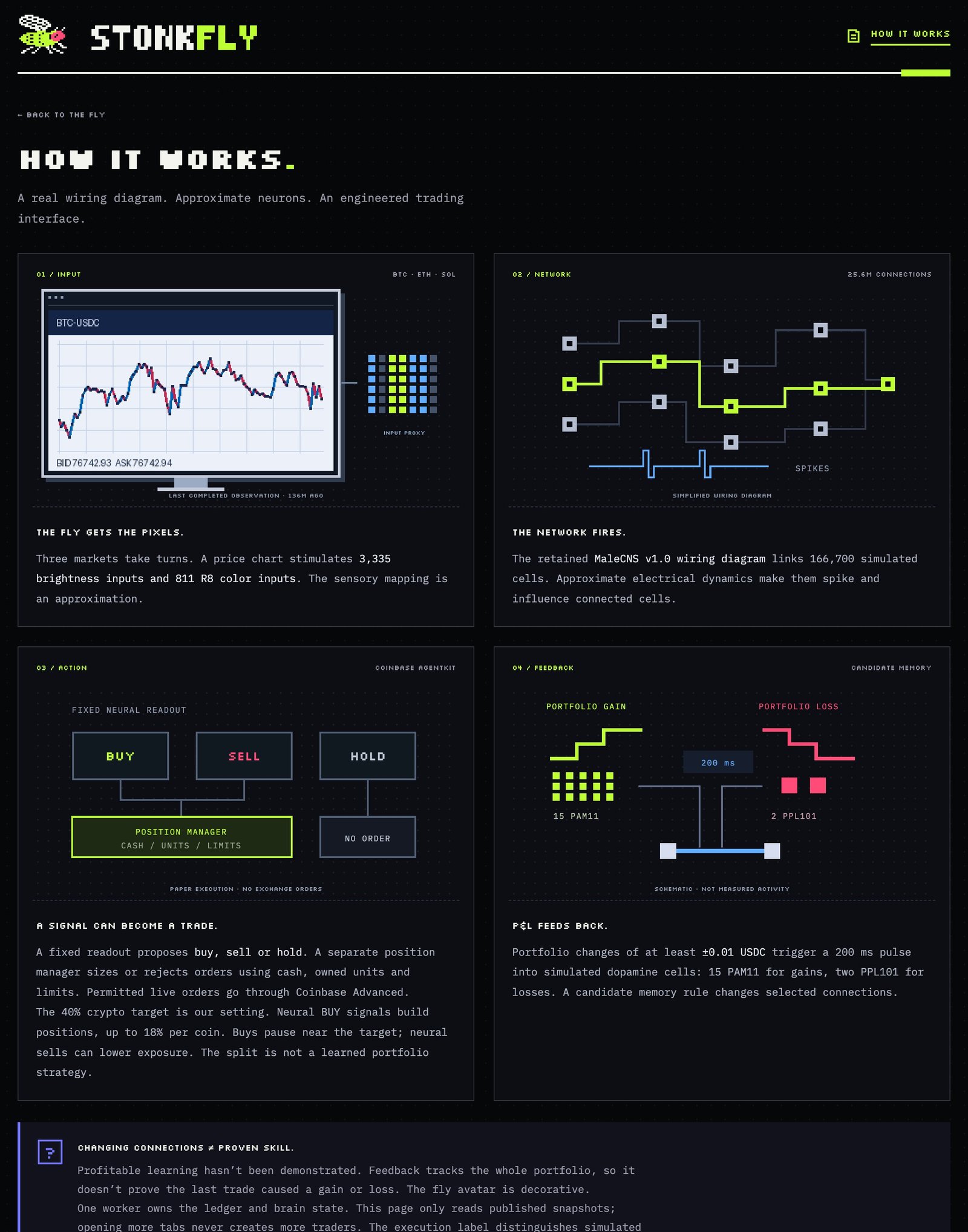
The fly does not get prices as numbers. Three markets take turns: bitcoin, ether, solana. A small chart of recent candles is turned into pixels. Those pixels stimulate 3,335 brightness inputs and 811 R8 color inputs. R8 cells are a real class of fly photoreceptor. The mapping, they write, is an approximation. The headline on that panel is: the fly gets the pixels.
A fixed readout then proposes buy, sell, or hold. A separate position manager sizes or rejects the proposal using cash, owned units, and limits: $10 per order, six attempts a day, a 60-minute cooldown, 18% of the bag in any one coin. The 40% crypto target is their setting. Neural buys build toward it. Buys pause near it. Neural sells can lower exposure. The split, they write, is not a learned portfolio strategy. Permitted live orders would go through Coinbase Advanced. The action panel on the page, when captured, read paper execution, no exchange orders.
When the whole bag moves by at least a hundredth of a USDC, they pulse simulated dopamine cells for 200 milliseconds: 15 PAM11 cells on a gain, two PPL101 cells on a loss. Those names are real types in the fly. A candidate memory rule then changes some connections. They print the caution in the same panel. Changing connections is not proven skill. Profitable learning has not been demonstrated. Feedback tracks the whole portfolio, so it does not prove the last trade caused a gain or a loss. The fly avatar is decorative.
One worker owns the ledger and the brain state. Extra tabs do not spawn extra traders. The brain observes about once a minute. The prices on the page refresh every second from Coinbase's public feed and do not trigger learning or trades.
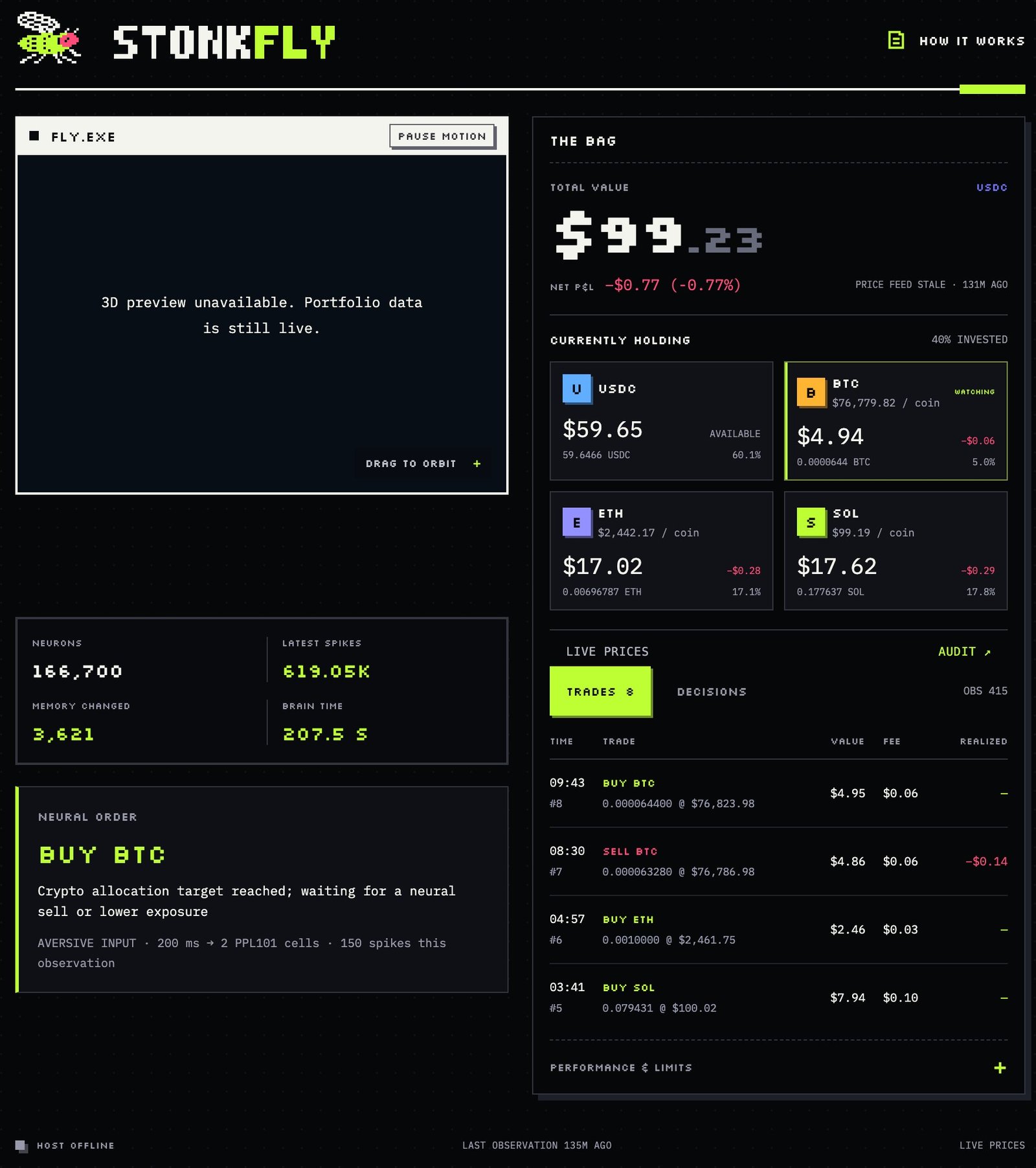
On that capture the bag was $99.23, down $0.77 from a $100 start. About $59.65 sat in USDC. The rest was bitcoin, ether, and solana, 40% invested across eight trades. Trade 7 was a bitcoin sell that realized a $0.14 loss. The public audit file labeled the run paper: local simulated fills at observed bid and ask plus assumed fees, no exchange orders, learning_validated false. The neural order on screen was buy bitcoin. The manager refused it. Crypto allocation target reached, waiting for a neural sell.