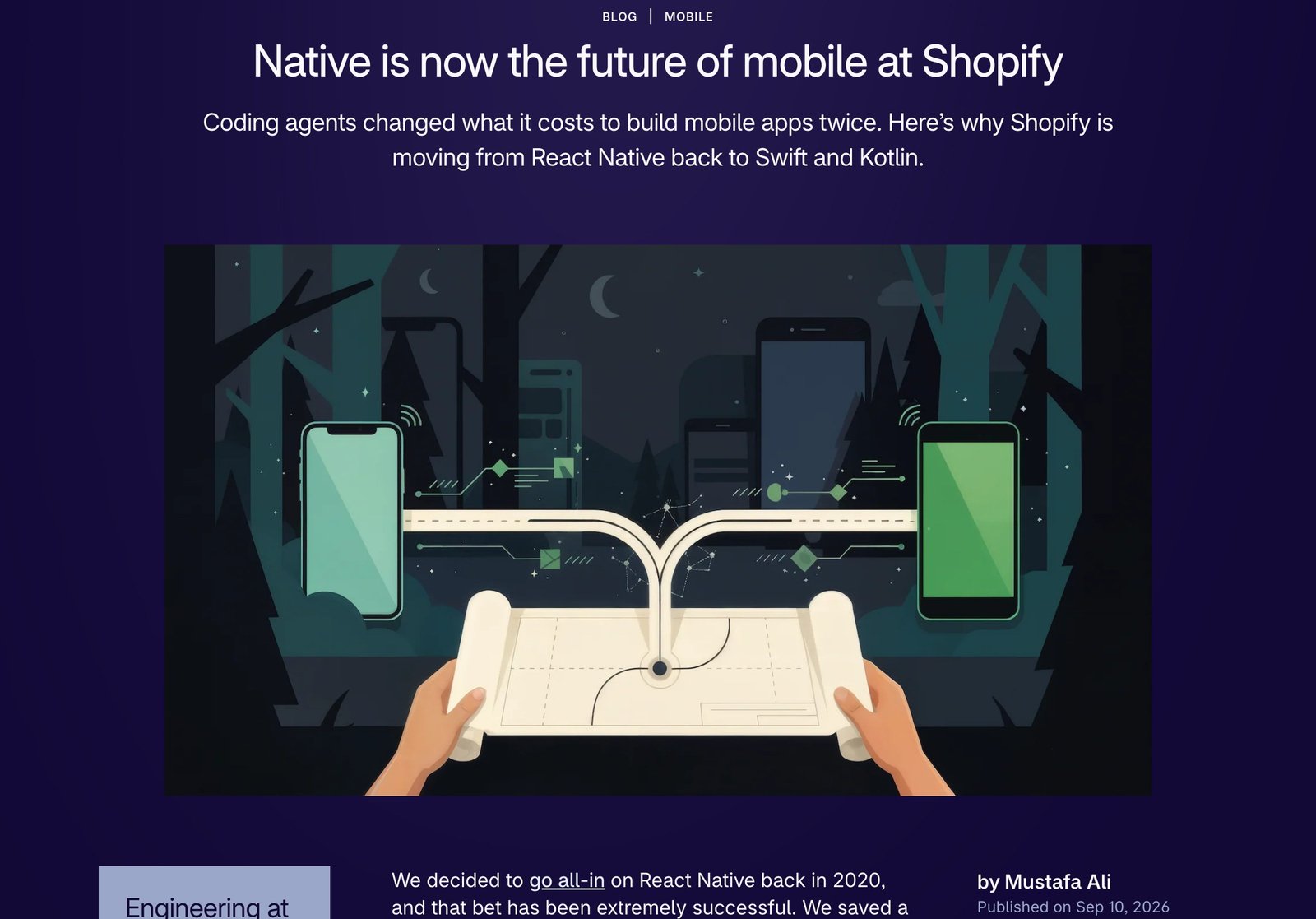
On 10 September 2026, Shopify published a post by Mustafa Ali titled Native is now the future of mobile at Shopify. The company went all in on React Native in 2020, and in January 2025 it published a follow-up saying the framework's future was bright and that it planned to keep investing.
The new post leaves that history intact. React Native, it says, remains an excellent framework, and the earlier assessment was true based on what was known then. The reversal is then put plainly in the standfirst: coding agents changed what it costs to build mobile apps twice.
The 2020 case rested on three things: stop building the same feature twice, let developers work across the stack, and spend less time chasing parity. React Native delivered those, alongside real costs. They spent significant time on performance work, on foundational areas of the framework, and on keeping up with framework updates and external dependencies. The post calls those acceptable tradeoffs.
Shopify has used LLMs to build software since 2021, a year before ChatGPT, starting with feature implementation, bug investigation, and code review. By late 2025, the models made them question whether building software twice still meant doing twice the work. They rebuilt core parts of their biggest apps in Swift and Kotlin with agents and were surprised by how well it worked. Agents implemented a feature on Android using the iOS version as a reference and the reverse, helped developers contribute outside their primary stack, and cut parity work through shared specifications, tests, and review checkpoints. They concede that native still means building and maintaining software on two platforms and that this cost has not disappeared. They also state the remaining benefit plainly: native keeps them closer to platform capabilities and first-party tooling, with fewer framework and dependency layers. React Native apps can be fast, and theirs are.
The open-source arrangements are laid out one by one. React Native Skia is sponsored through the end of 2026, after which William Candillon continues on it, forks the repository, and republishes under a new name while the original is archived. FlashList, at roughly 2 million downloads a week, will keep receiving critical compatibility fixes while Shopify discusses long-term stewardship with several companies. Restyle is being archived: it keeps working through the end of 2026, then maintenance stops, and anyone is welcome to fork it.
On migration, they chose greenfield over brownfield this time, where in 2020 they had chosen brownfield. The Shop app went from proof of concept to a rebuilt native app published in the app stores in 12 weeks, assisted by AI. The Shopify app, their largest, with more than 300 screens, home and lockscreen widgets, an Apple Watch app, complications, and Siri Shortcuts, is underway and ships later this year.
Pointing a model at the React Native codebase and one-shotting the native version does not work, the post says, even after freezing specifications and task files up front, because the output is unmaintainable and cannot ship. Their answer is a system called Helix. A developer points it at a screen, Helix reads the React Native code and proposes ordered checkpoints that can be reviewed in minutes, and each checkpoint must pass tests, match the running app in a visual review, survive two adversarial code reviewers, and get a human sign-off before it is committed. Feedback from each review is retained, so the loop gets more autonomous as the migration proceeds.
They also reworked the feedback loop itself. Simulator control was the bottleneck, because agents learned app state from the accessibility tree or from screenshots and needed minutes per iteration. They restructured the apps so business logic runs headlessly on a desktop behind a CLI, which lets agents inspect state, navigate, and act in milliseconds, and drive simulators over a remote mode without inspecting layout. Everything else, they write, will follow the same path, with success measured by product velocity, app quality, and how much work agents complete autonomously.
Editorial
This is an unusually well-argued reversal, and it rests on one claim that is not yet evidenced at the scale being bet on. The prototypes worked, the Shop app has shipped, the Shopify app is in flight, and the rest of the portfolio is a plan with a stated ship date later this year.
The interesting move is a swap in kind rather than degree. React Native shared source, which is deterministic: one code path, one place a bug lives, one review surface. What replaces it is shared specifications plus agent translation plus a verification harness, which is probabilistic. Shopify's own section on slop is the evidence that the harness is not optional. Helix requires per-slice tests, a visual match against the running app, two adversarial reviewers, and a human sign-off before every commit, which is a great deal of machinery to make the cheaper path work. It can still come out cheaper, since the machinery is built once and amortized across every screen. It is a cost the 12-week figure does not price.
Two risks go undiscussed. If one specification generates both implementations, an error in it propagates to two different native shapes, and you cannot diff your way to it the way a single shared code path sometimes allowed. And two native codebases mean two audit surfaces and two release trains for as long as those apps exist. They concede the cost has not disappeared without saying what it looks like in year three.
The principle underneath is not specific to mobile. An abstraction earns its keep while the thing it hides is expensive. Make the hidden work cheap and the abstraction starts behaving like a liability: leaky, churning on versions, standing between you and the platform you are targeting. Shopify is the first company I have seen state that logic explicitly for a public framework decision, and it transfers to ORMs and cross-platform UI layers, and to a fair amount of what gets called architecture.
The ecosystem cost is real, and their handling is better than the norm. FlashList is infrastructure for a great many apps and now needs a steward. Skia moves to a fork under a new name, which puts migration work on its users. Restyle loses maintenance after this year. And Shopify was React Native's strongest large-scale production reference, so its exit is a harder data point for the framework than the same post from a small team would be. The acknowledgements read like a eulogy, which I take as sincere.
What would settle it is mostly measurable. Crash rates and feature parity at Shop's ship date, the team size against the React Native team that built the same app, how much of the surface was human-written, and whether the second migration traces the same 12-week curve once the novelty of the first one is gone. If the Shopify app ships on schedule at comparable quality, the argument holds and other large mobile teams will follow. If it slips into next year, the assumption was premature, and they will be maintaining two native codebases regardless.