Most debates about artificial intelligence and jobs start from the wrong intuition: they assume hard intellectual work is safe while routine work goes first. In Messy Jobs: The Work That AI Cannot Reach (Upriver Press, June 2026), economists Luis Garicano of the London School of Economics and Jin Li and Yanhui Wu of the University of Hong Kong argue that difficulty offers almost no protection. Chess was hard, and computers mastered it early. Instead, messiness protects a role: how tightly its tasks are bound together by judgment, coordination, accountability, tacit knowledge, and human relationships.
On November 26, Hugging Face co-founder Thomas Wolf shared a 15-card visual primer of the book on X, pairing the authors' organizational-economics framework with historical data from William Nordhaus, the US Census, the FDA, and the St. Louis Fed. Those 15 cards trace one continuous argument from macro labor history down to hiring, management, and early-career training.
What stays scarce when thinking gets cheap
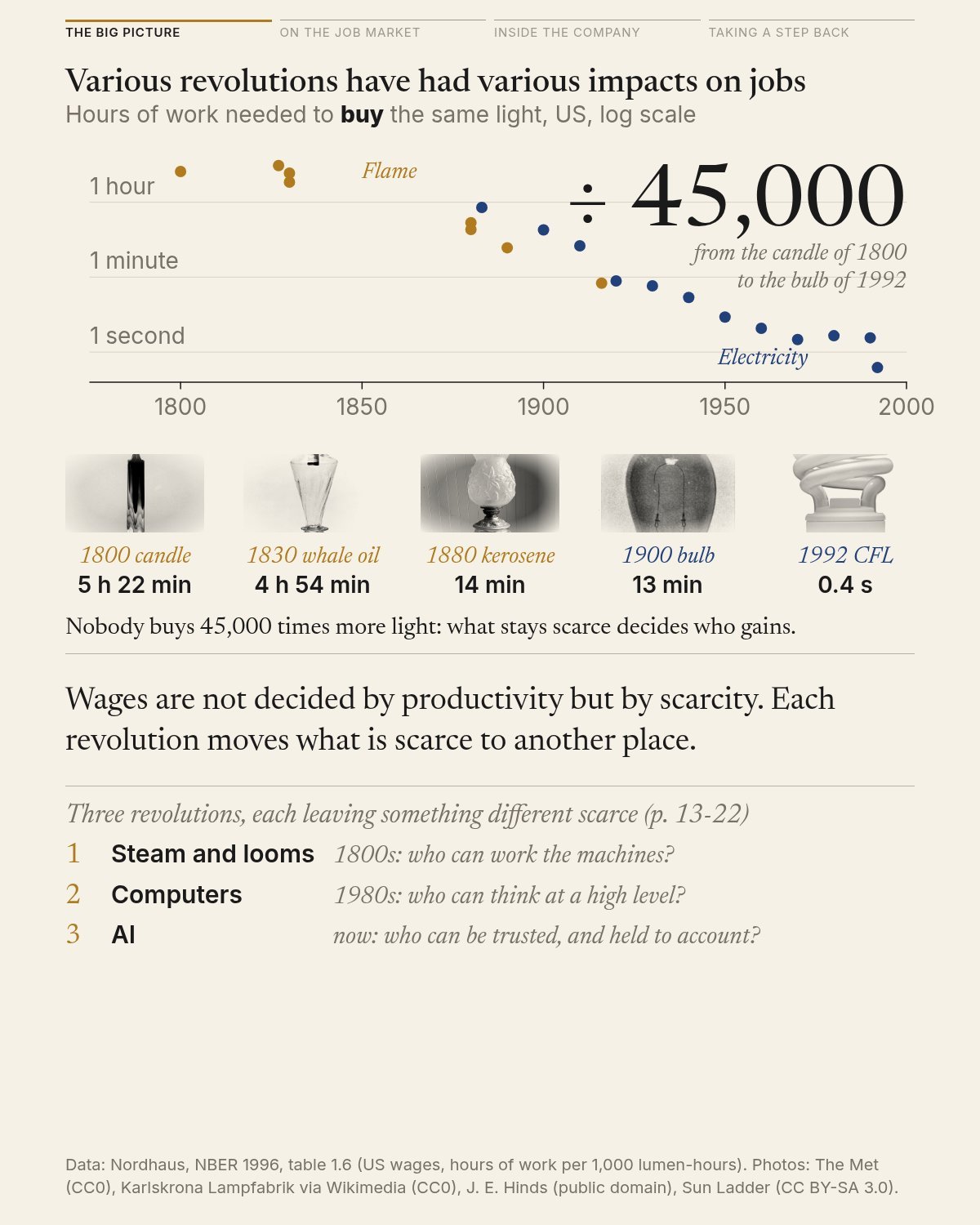
Technology rarely pays workers for higher raw output; wages follow whatever remains scarce. Drawing on Nordhaus's 1996 study of artificial light, the book notes that the labor hours needed to buy 1,000 lumen-hours fell 45,000-fold between the tallow candle of 1800 (5 hours 22 minutes) and the compact fluorescent bulb of 1992 (0.4 seconds). Nobody buys 45,000 times more light, so each industrial wave simply moves the bottleneck somewhere else: operating machines in the 1800s, high-level analysis in the 1980s, and trust plus accountability in the AI era.
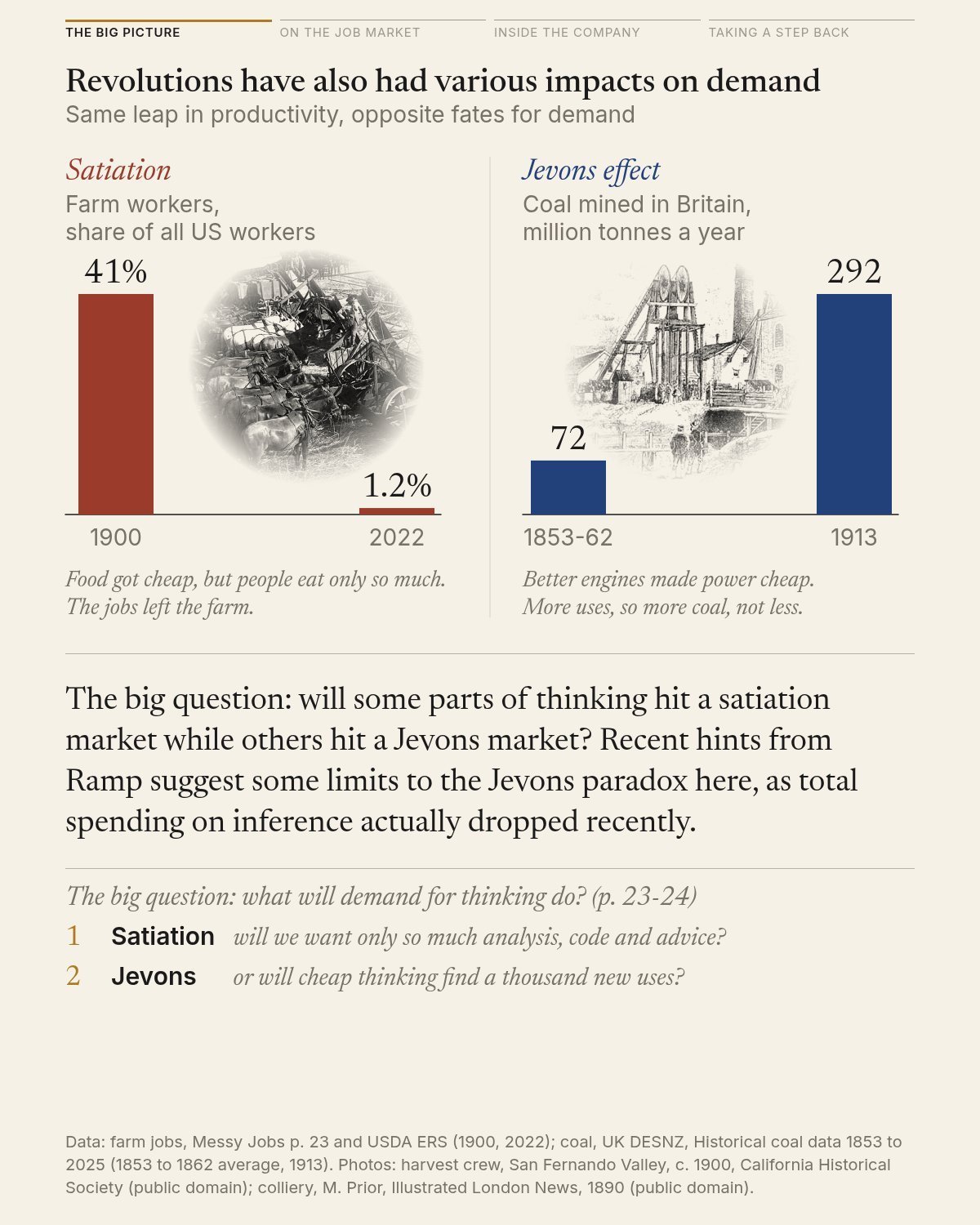
Even when a technology slashes unit costs, demand does not respond the same way across sectors. When agriculture got radically more productive, food satiation meant people ate only so much, and farm jobs shrank from 41 percent of US employment in 1900 to roughly 1 percent in 2022. When better steam engines made coal power cheaper, industrialists found new uses and British coal output climbed to 292 million tonnes a year by 1913, the classic Jevons rebound. For white-collar work, the open question is which kinds of analysis hit satiation and which trigger new demand.
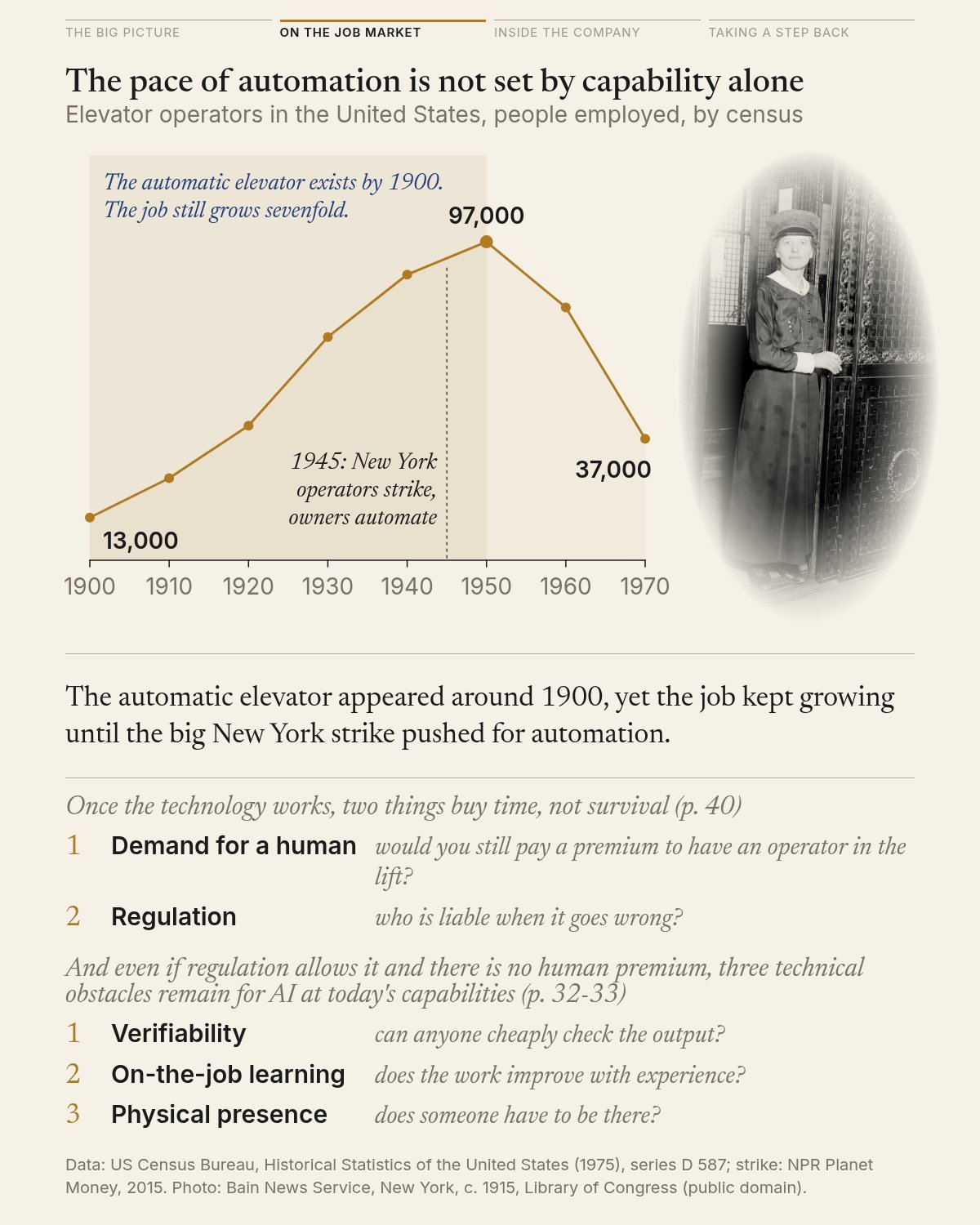
Nor does technical capability set the pace of replacement on its own. Automatic elevators existed by 1900, yet US Census records show elevator operator employment grew sevenfold to 97,000 by 1950 before falling to 13,000 in 1970 after a 1945 New York operators strike pushed building owners to automate. Preference for human presence and liability rules buy time, alongside three remaining technical hurdles for AI: cheap output verification, on-the-job learning, and physical presence.
Task bundles, authority, and the human premium
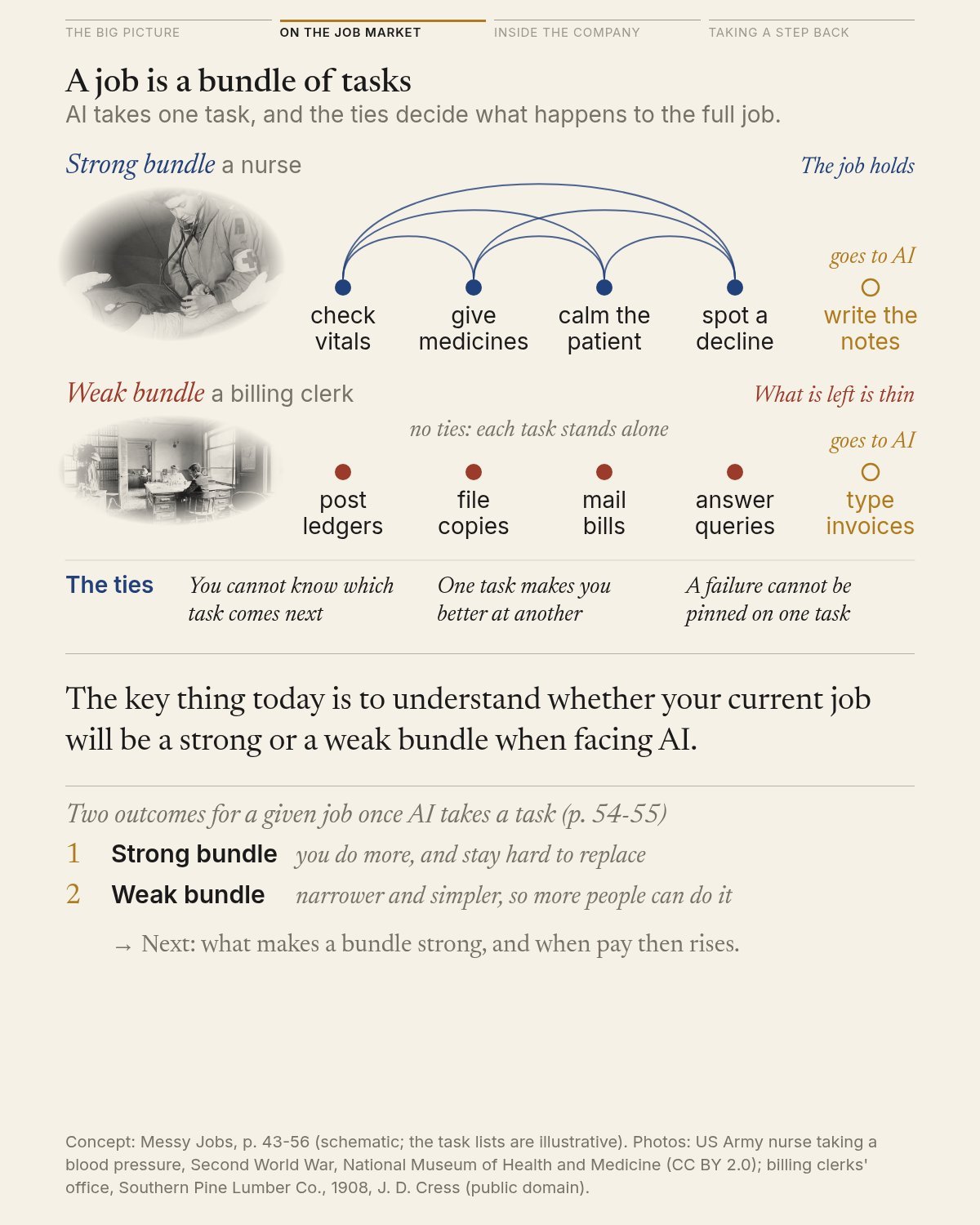
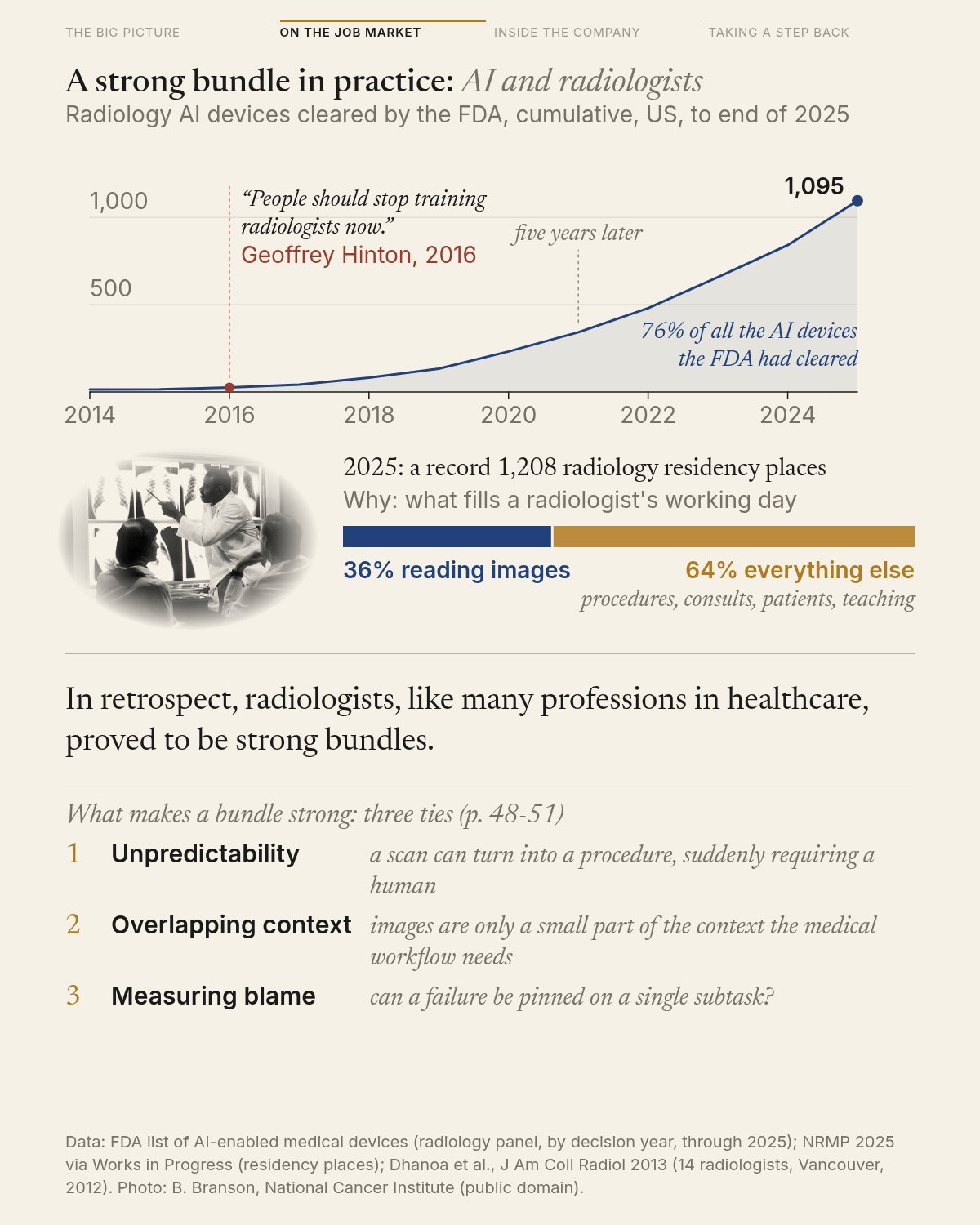
Because capability alone does not eliminate a role, the authors look inside the job itself. Building on Ronald Coase and Gary Becker's work on the division of labor, they treat a job as a bundle of tasks held together by three ties: unpredictability in what comes next, overlapping context where doing one task improves another, and shared blame when outcomes fail. A nurse's role holds together as a strong bundle even if software handles charting, while a billing clerk's standalone tasks peel apart one by one.
Radiology is the book's clearest test of that bundling logic. In 2016, Geoffrey Hinton argued that hospitals should stop training radiologists. By the end of 2025, the FDA had cleared 1,095 radiology AI devices, accounting for 76 percent of all cleared AI medical devices, yet 2025 still set a record with 1,208 US radiology residency places. Time-motion data cited in the book shows why: radiologists spend 36 percent of their day reading scans and 64 percent on procedures, consults, patients, and teaching.
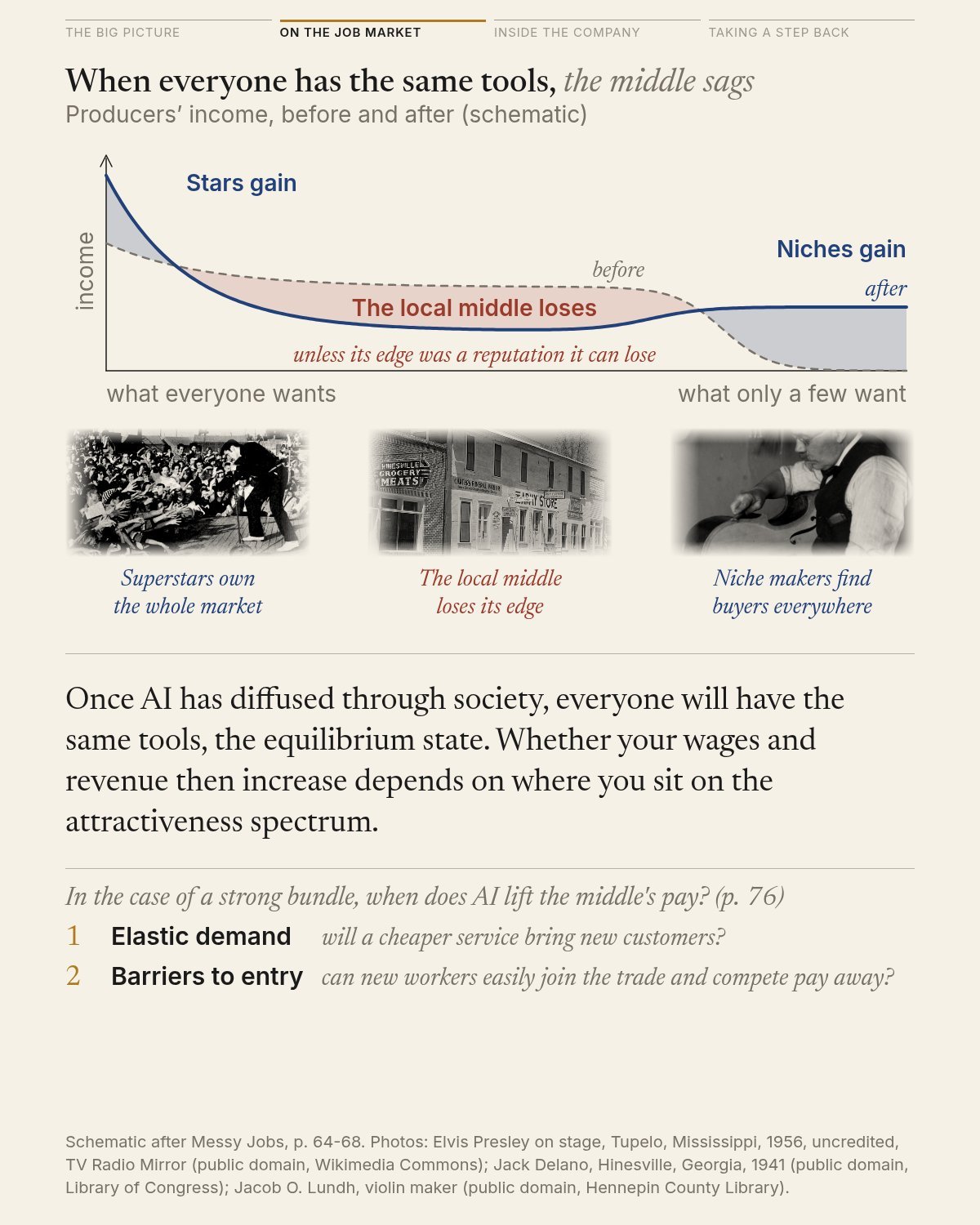
Surviving as a strong bundle does not guarantee higher pay for everyone inside it. Once everyone has access to the same model, top stars reach global scale and narrow niches find buyers everywhere, while mid-tier local providers lose their edge unless personal reputation shields them. Even inside strong bundles, wages rise only when lower service prices bring in new customers (elastic demand) and barriers to entry stop displaced workers from flooding the trade.
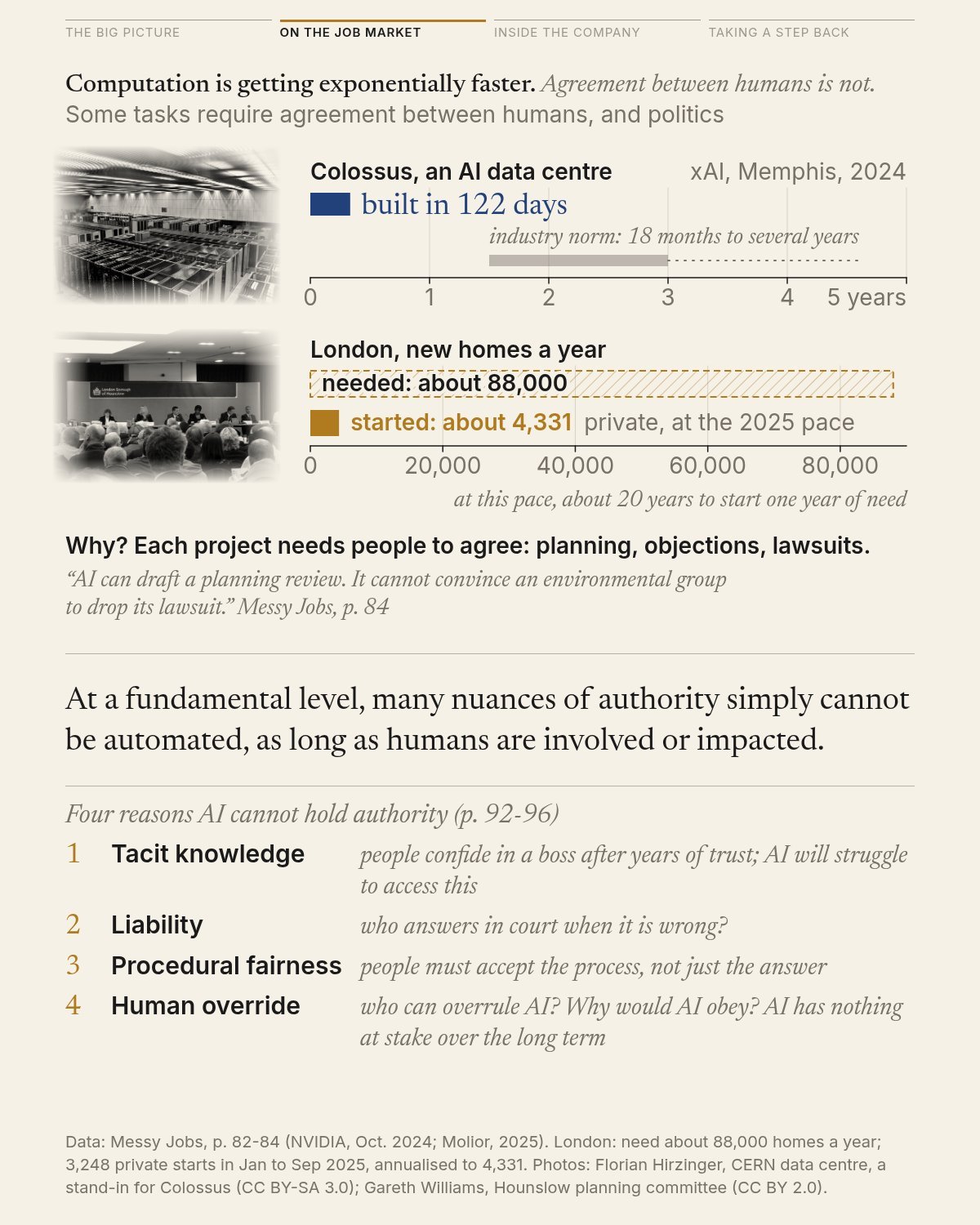
Beyond task bundles, human agreement sets its own hard ceiling on what models can run. xAI built its Colossus data center in Memphis in 122 days in 2024, whereas London's private housing starts ran near 4,331 annualized homes in 2025 against roughly 88,000 needed per year. AI can draft a planning brief, yet it cannot persuade an environmental group to drop a lawsuit. The book lists four reasons AI cannot hold authority: tacit trust built over years, legal liability, procedural fairness, and the need for a human override with long-term stakes.
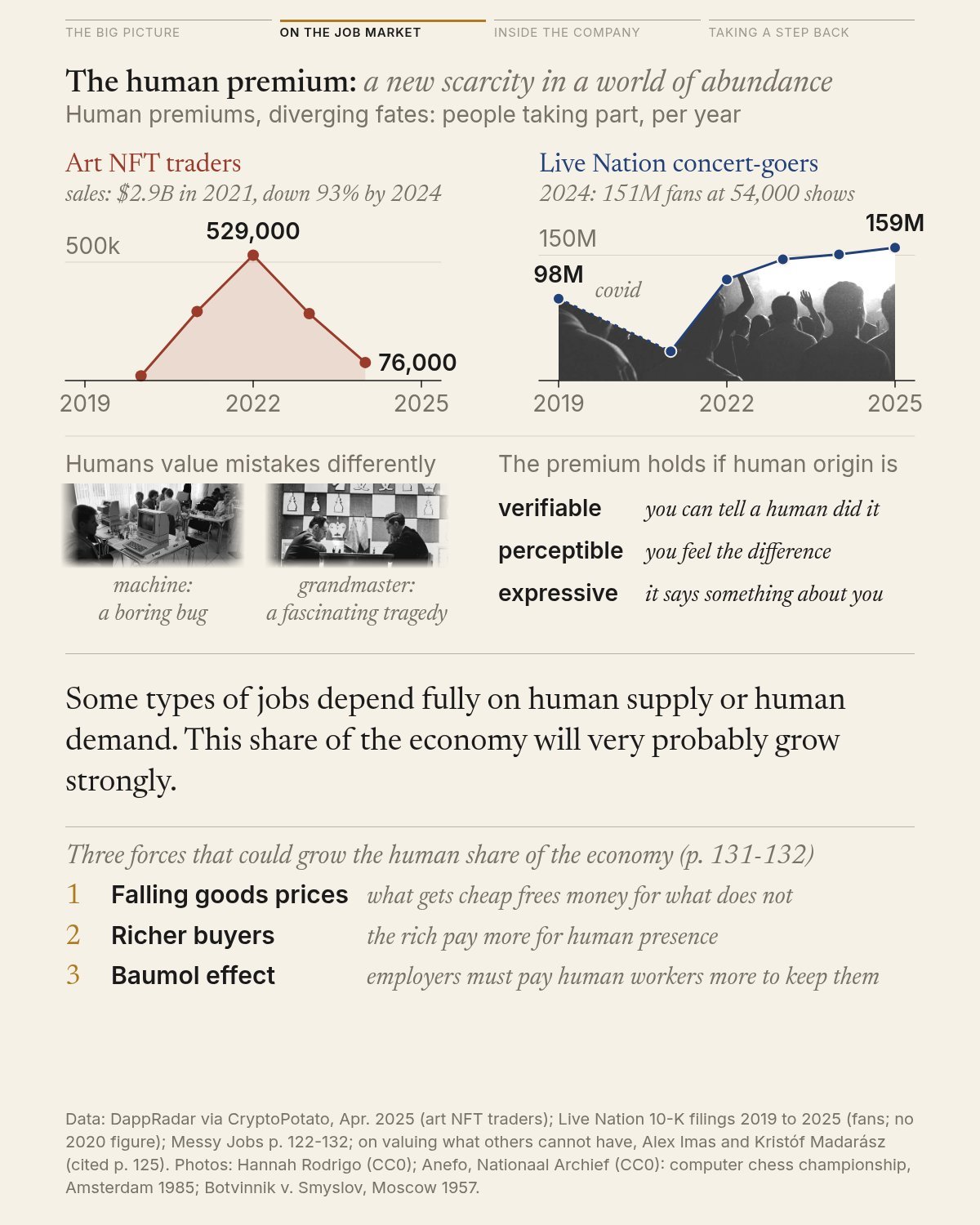
At the same time, cheap digital abundance pushes buyers toward verifiable human origin. While art NFT trading dropped 93 percent from its $2.9 billion peak in 2021 to 76,000 traders in 2025, Live Nation concert attendance climbed from 98 million in 2019 to 159 million in 2025. Humans judge errors differently depending on who made them: a software slip is a boring bug, while a grandmaster's blunder is drama. Falling goods prices, wealthier buyers, and Baumol's cost disease, where employers must raise pay in slow human sectors to keep staff, all push spending toward human presence.
Why companies stall, and where workslop hits
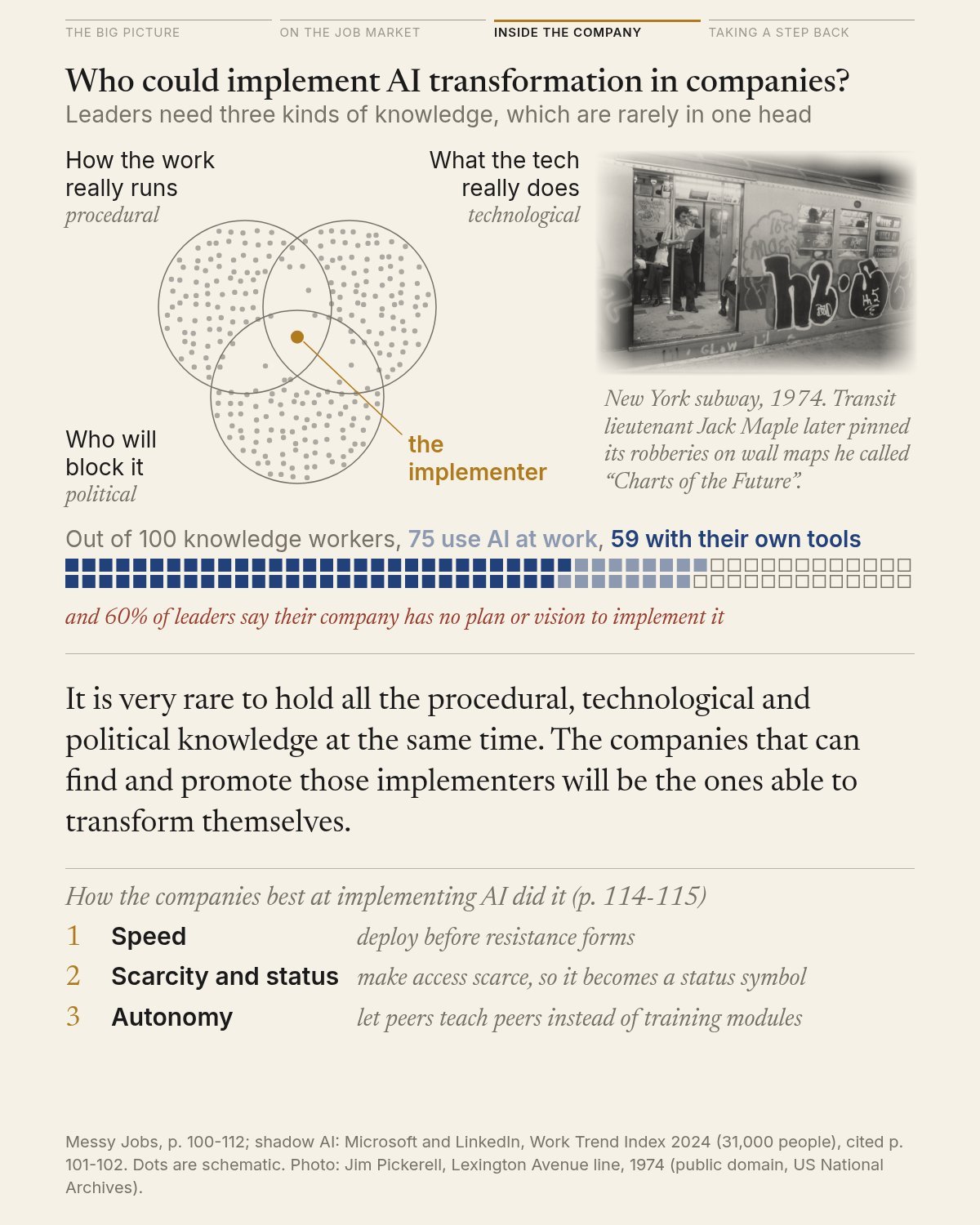
Inside organizations, the bottleneck shifts from whether the model works to who understands enough to rewire the workflow. A Microsoft and LinkedIn survey of 31,000 workers found 75 percent of knowledge workers using AI, 59 percent bringing their own tools, and 60 percent of leaders admitting their firm has no implementation plan. The rare implementers who combine how work actually runs, what models do, and who will block change are the ones who ship workflow redesign, often by deploying fast and letting peers teach peers.
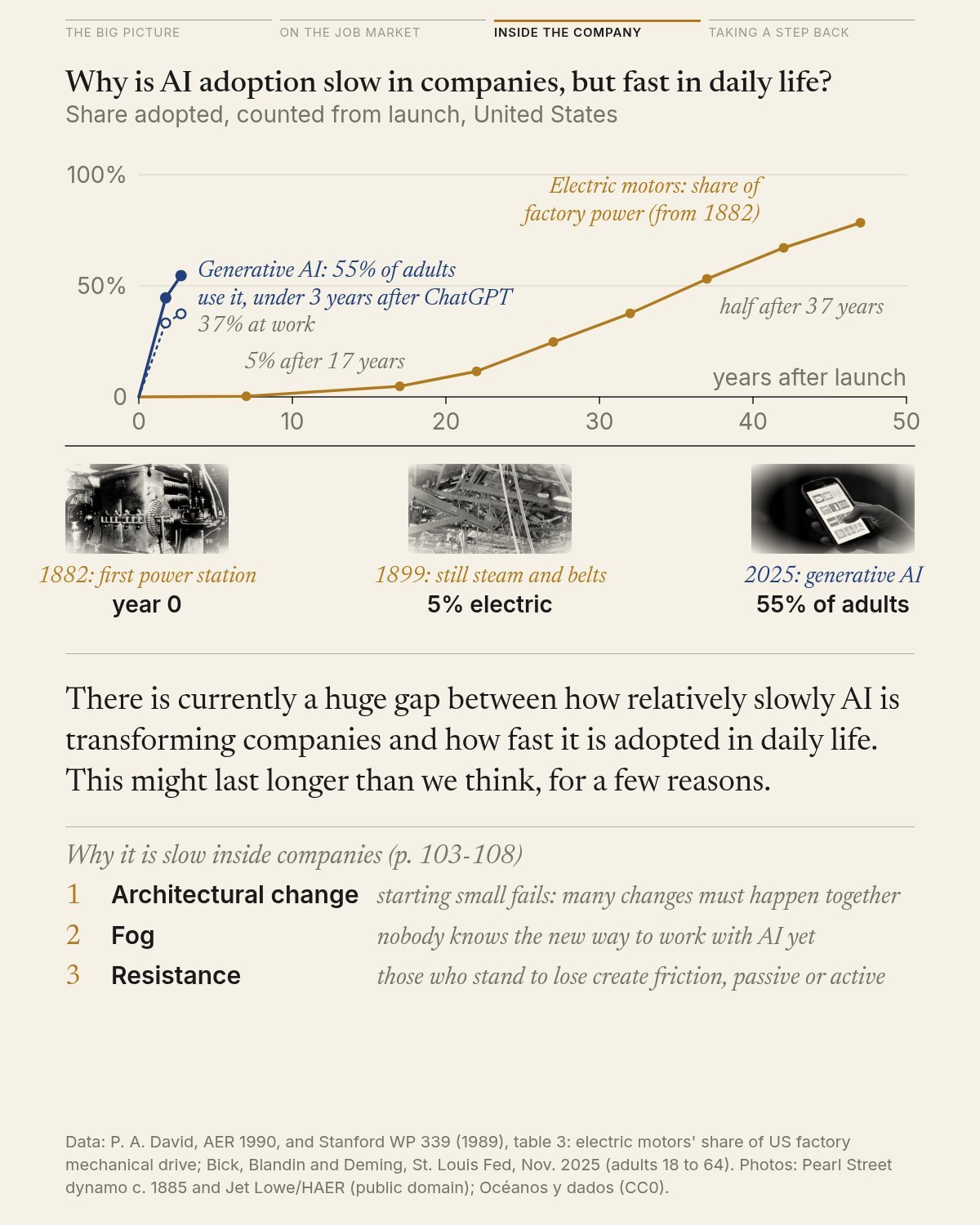
That gap between personal adoption and corporate restructuring has historical precedent. St. Louis Fed data from November 2025 shows 55 percent of US adults using generative AI within three years of ChatGPT's launch and 37 percent using it at work. By contrast, economic historian Paul David showed that electric motors powered only 5 percent of US factory drive 17 years after the 1882 Pearl Street power station. Reaching half took roughly 37 years because factories had to tear out overhead line shafts and rebuild around unit drive.
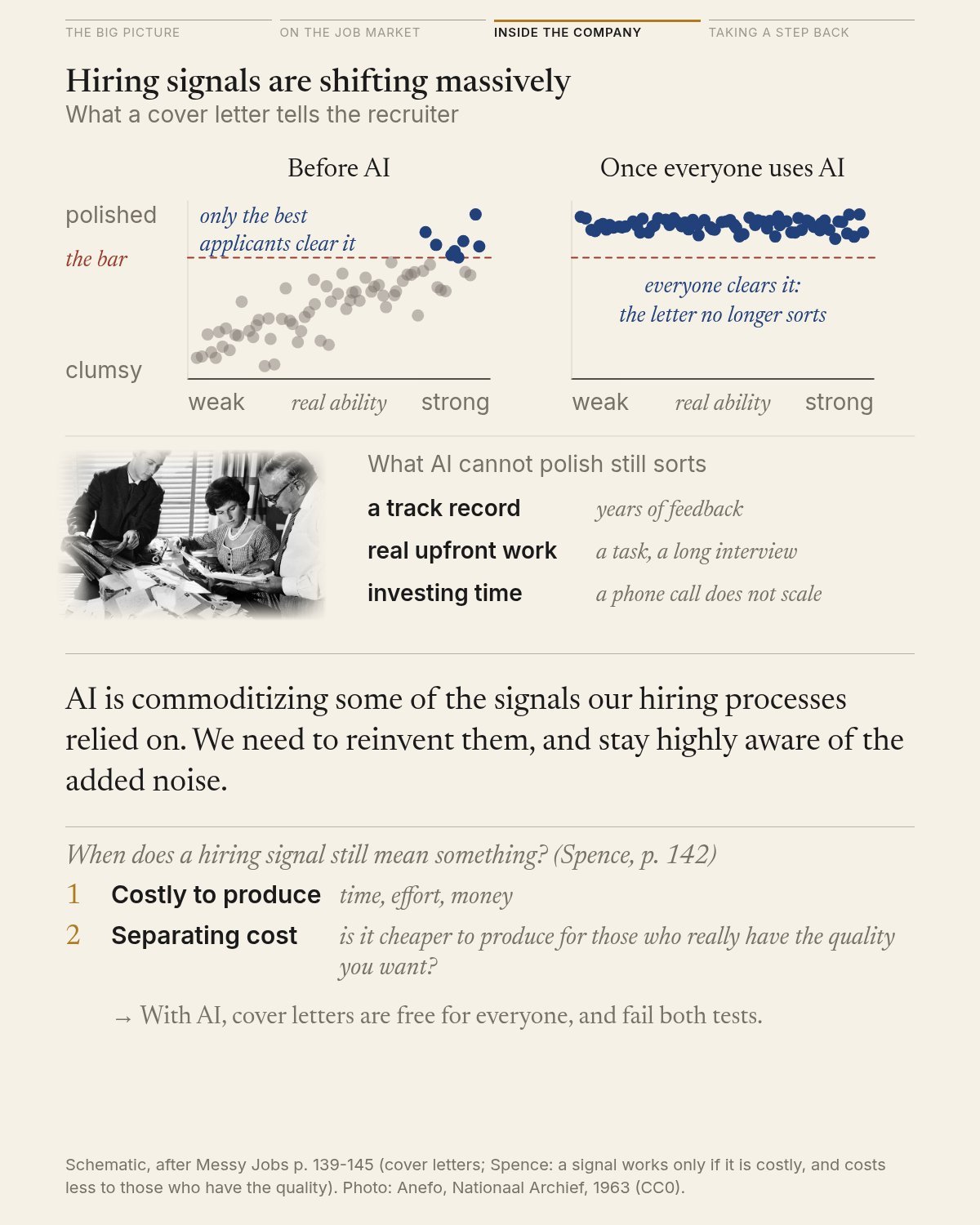
Even before firms redesign their workflows, cheap text generation breaks old hiring filters. Under Michael Spence's signaling theory, a credential works only when it is costly to produce and cheaper for high-ability candidates than weak ones. Cover letters and polished writing samples fail both tests once anyone can generate them in seconds, forcing recruiters toward harder-to-fake signals such as track records, real upfront work samples, and live conversations.
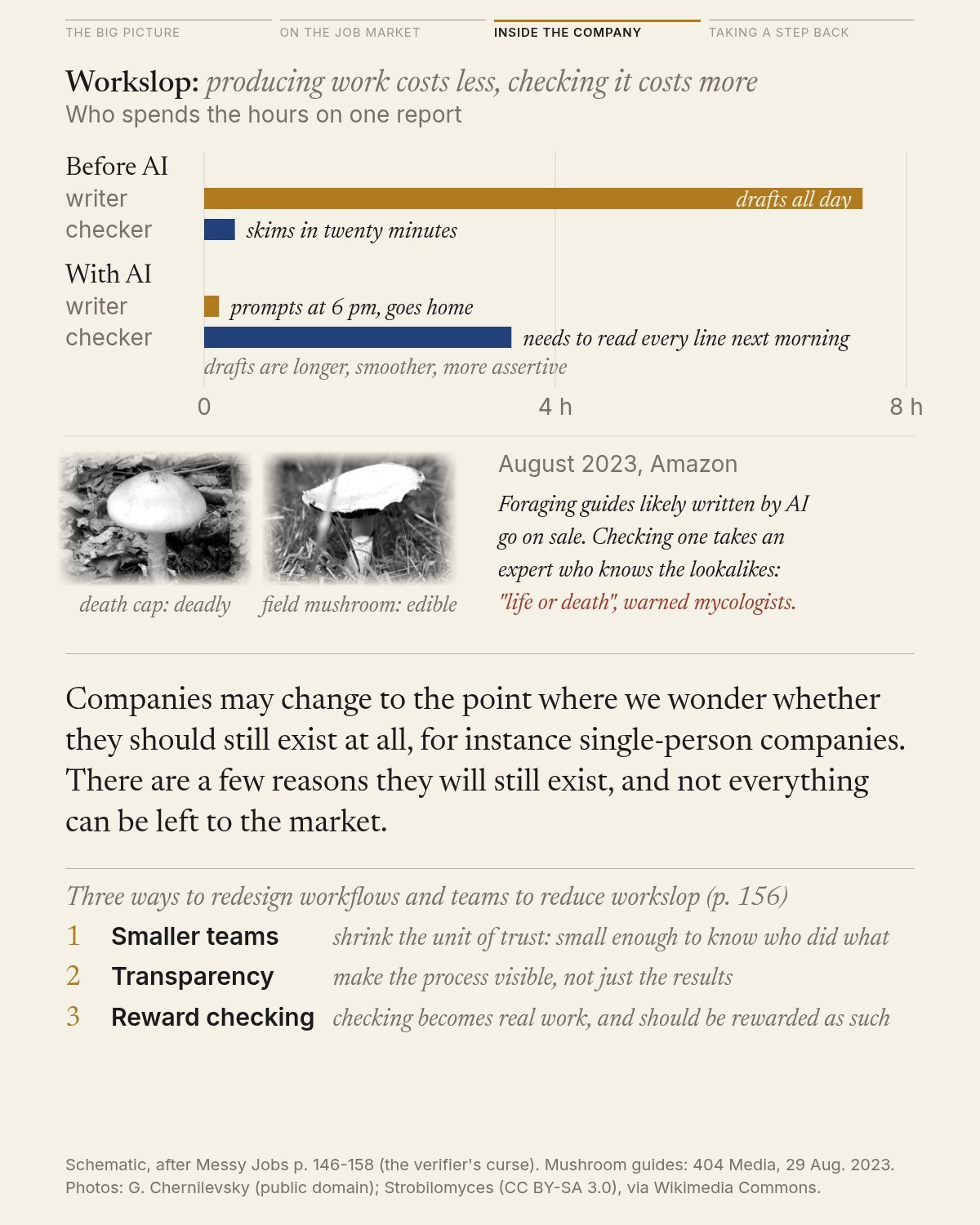
The same asymmetry shows up inside daily team output as "the verifier's curse": an employee prompts a polished report at 6 pm and goes home, leaving a manager to check every line the next morning. Card 12 cites the August 2023 wave of AI-generated mushroom foraging guides on Amazon, where mycologists warned that misidentifying lookalikes was life or death. Shrinking teams so everyone knows who did what, making the process visible, and paying people for checking are how the authors argue firms beat workslop.
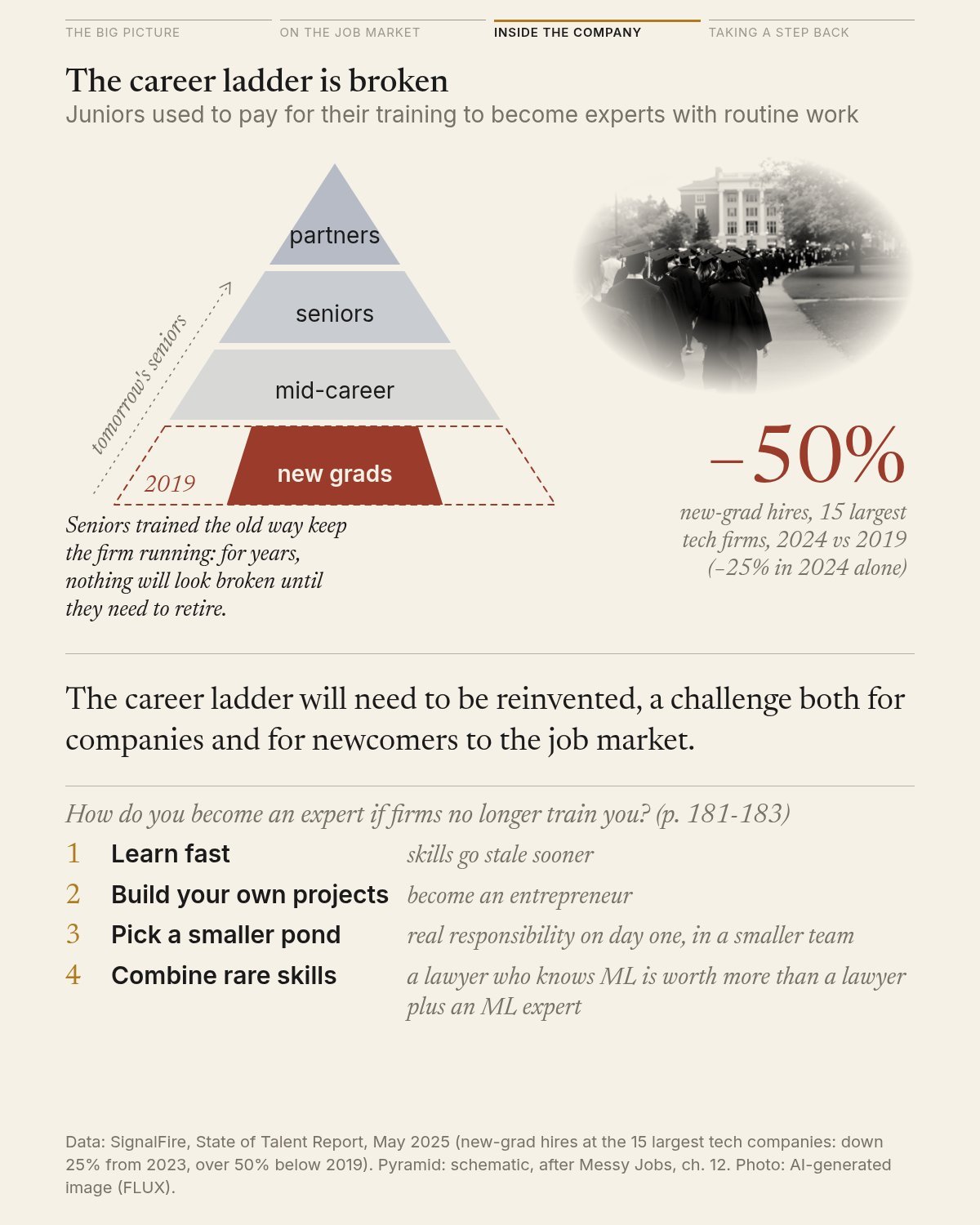
Entry-level training suffers a parallel squeeze because juniors traditionally paid seniors for mentorship by handling routine slide decks, spreadsheets, and document checks. SignalFire's May 2025 report found new-graduate hiring at the 15 largest tech firms down 25 percent from 2023 and more than 50 percent below 2019. Seniors trained under the old model keep firms running for years, hiding the pipeline break until they retire.
The 90-percent plateau and bounded macro growth
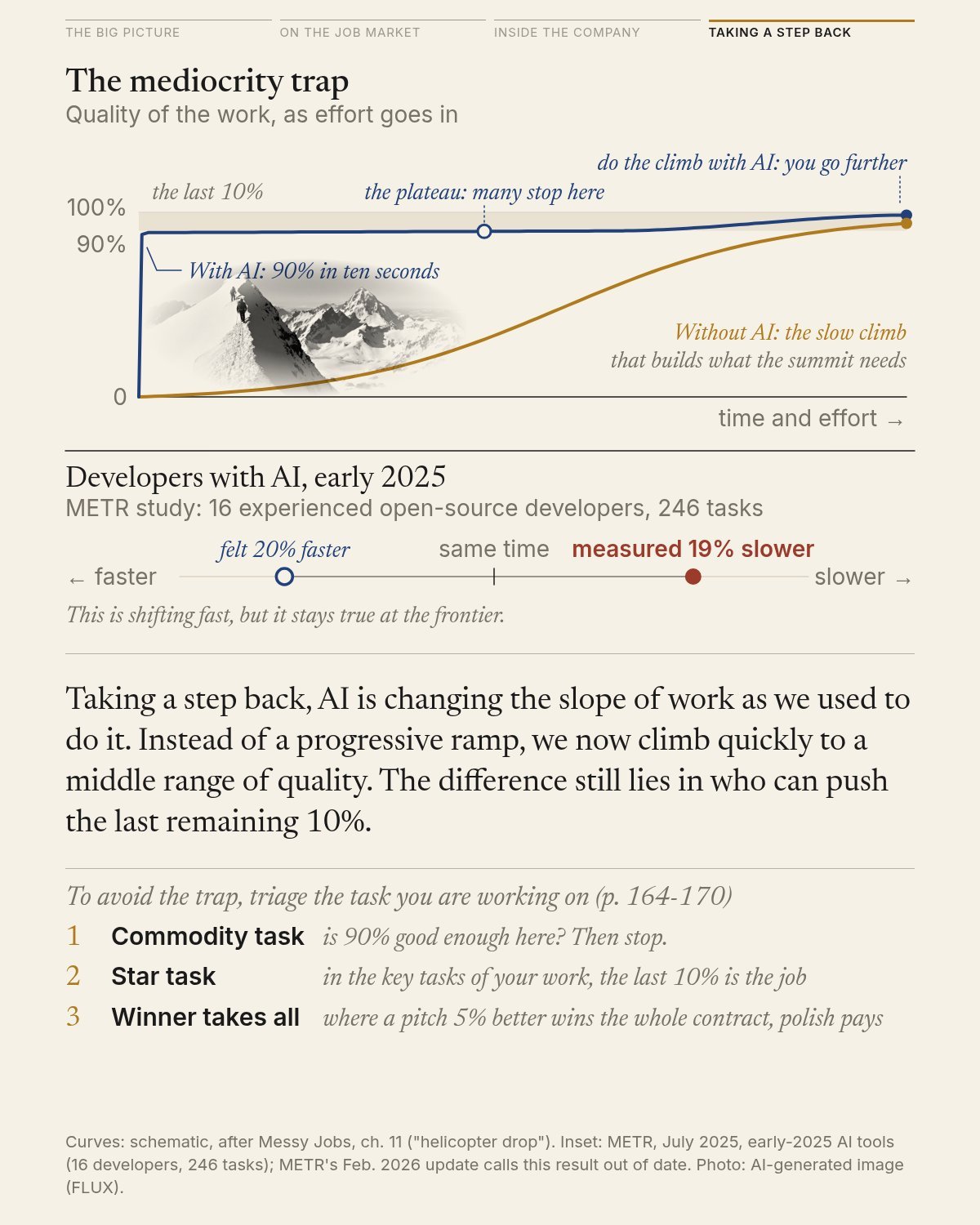
At the individual level, the authors compare AI to a helicopter drop onto a mountainside: workers reach 90 percent quality in ten seconds, which tempts many to stop there rather than climb the remaining 10 percent that separates commodity output from star work. The card cites METR's July 2025 study of 16 experienced open-source developers who felt 20 percent faster with early-2025 tools while measuring 19 percent slower, alongside METR's February 2026 note that the timing result is now out of date.
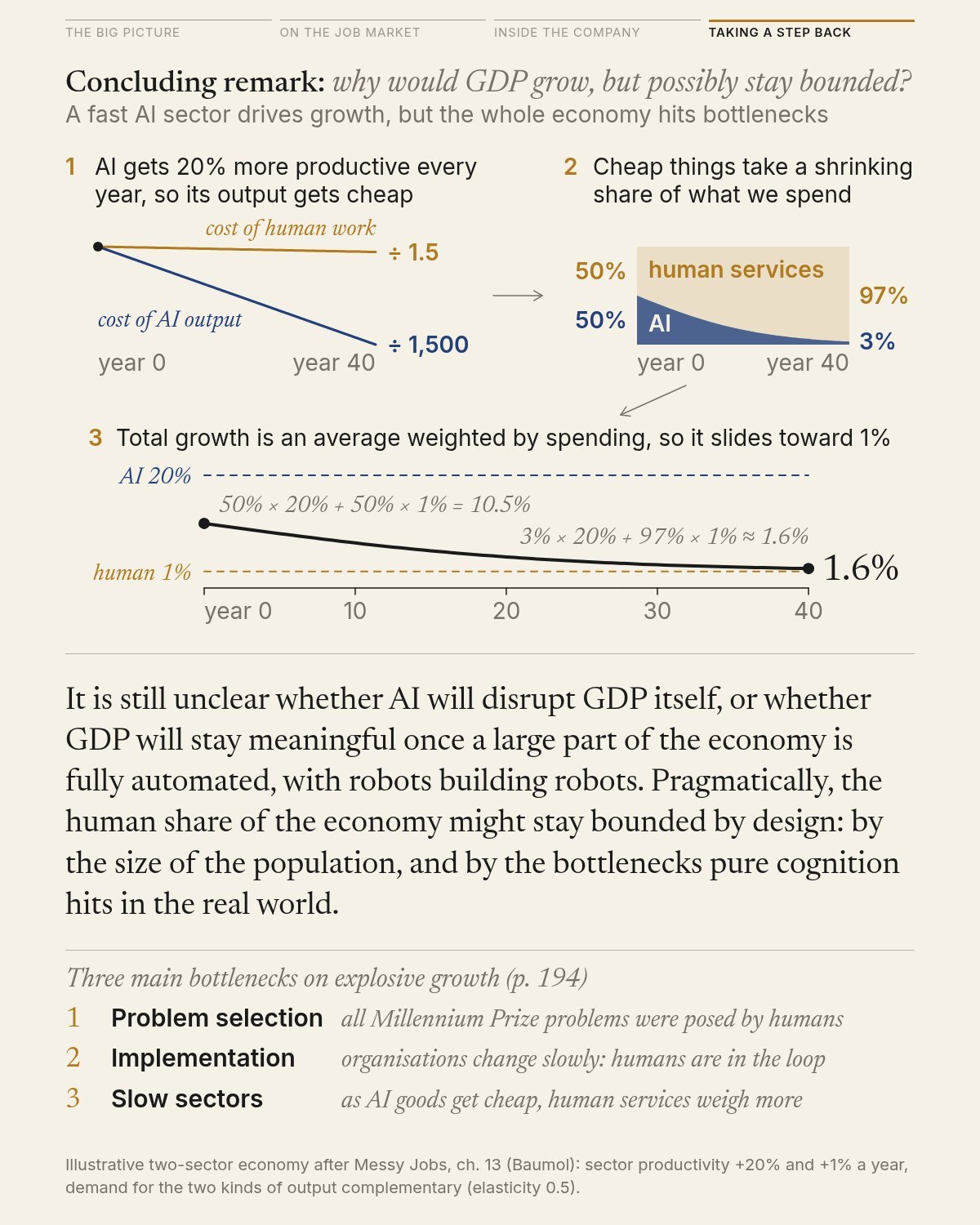
Zooming out to the whole economy, those slow human bottlenecks cap how fast aggregate GDP can accelerate. In an illustrative two-sector Baumol model where AI output grows 20 percent more productive each year and human services grow 1 percent (with complementary demand elasticity of 0.5), AI output gets so cheap that it shrinks from 50 percent of total spending to 3 percent over 40 years while human services expand to 97 percent. Aggregate GDP growth slides from 10.5 percent toward 1.6 percent as slow physical and relational sectors take up nearly the entire spending basket.
Editorial
Messy Jobs replaces vague arguments about model intelligence with organizational price theory, and the three chapters on verification, signaling, and junior training explain what software and operations teams are actually hitting right now. Drafting got cheap while reviewing stayed slow, and teams never added review capacity. When one developer or analyst can generate ten pages of plausible prose or three pull requests before dinner, the bottleneck moves immediately to the person whose signature is on the outcome. Unless organizations shrink units of accountability and explicitly pay for checking, AI adoption looks fast in seat counts and flat in shipped quality.
That verification bottleneck also connects directly to the broken junior ladder. Firms that cut new-graduate hiring by half because models handle routine slides and boilerplate code are quietly consuming their own future senior judgment. You do not learn to spot a subtle edge case in a generated report or a shaky architecture choice in a pull request by reading finished answers; you learn it by doing the messy intermediate climb that AI now skips over. Companies that treat junior work as expendable will not notice the damage for five years, until the seniors trained the old way start retiring.
Even with those strengths, I think the sharpest challenge to the book comes from University of Chicago economist Luigi Zingales, who told Garicano that "messiness is endogenous." How messy a job looks today reflects how firms currently choose to organize work, not a permanent law of nature. Nineteenth-century interchangeable parts did not replicate a gunsmith's tacit craft; they reorganized the factory so that craft was no longer needed, and buyers accepted standardized products at a fraction of the price. Even if AI never matches the human touch in a bundled role, firms may still accept a cheaper, standardized substitute and let platforms capture the margin. The book is right that messiness protects workers today, though how long a bundle stays tied together depends on how aggressively organizations are willing to redesign around it.