@forallcurious posted the map that always stops a scroll: a filamentary continent of galaxies, and a tiny red dot labeled as us.
Our galaxy appears to be part of a structure so large it challenges our current models of Cosmology!
(The tiny little red dot is us.)
— All day Astronomy (@forallcurious), 23 Jul 2025
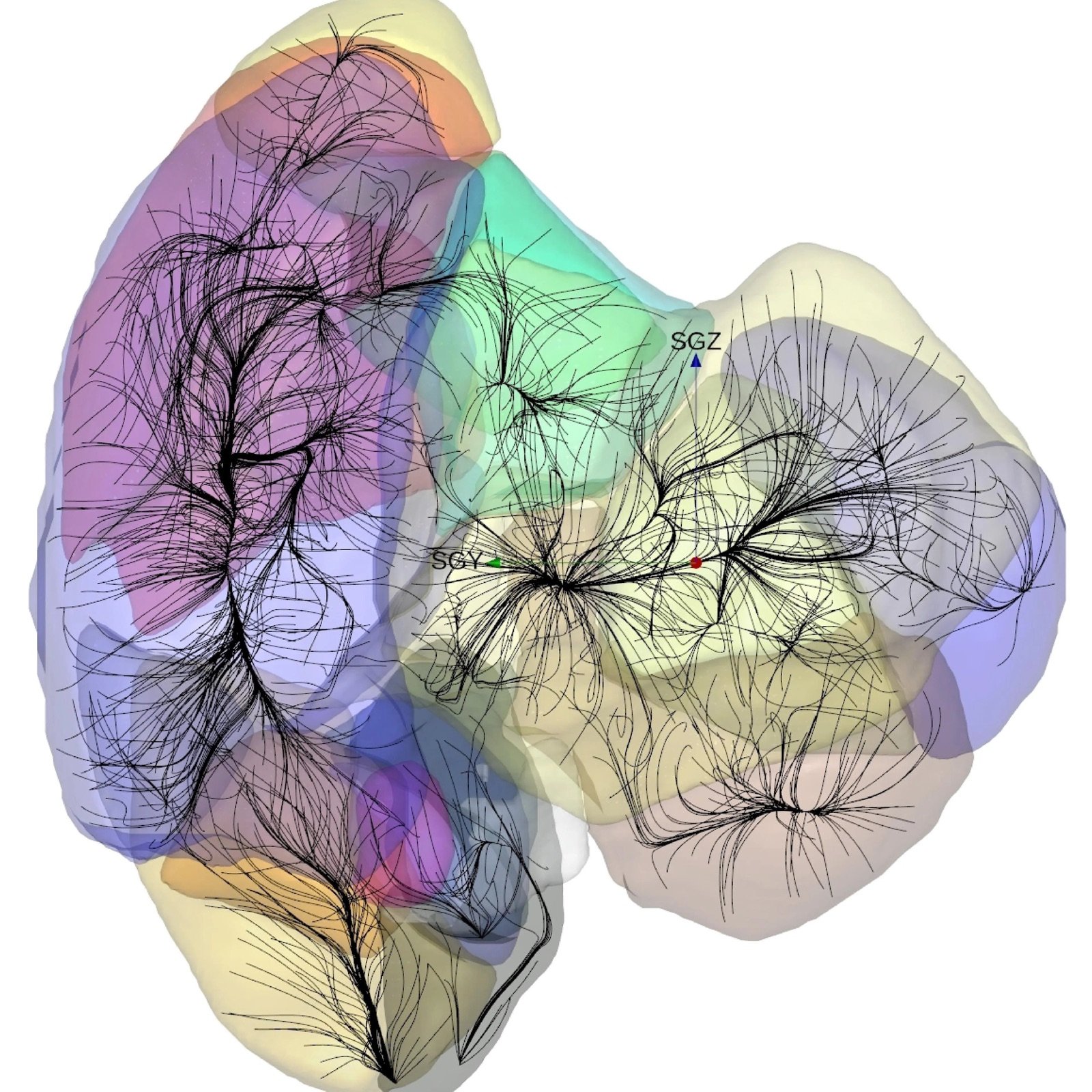
The picture is real science, and the red dot is real. The punchline in the tweet is doing more work than the paper will support. The 2024 result is not “ΛCDM is broken.” It is: we still have not found the outer rim of the gravitational watershed we live in.
Your cosmic address, nested
Start small and walk out. Earth sits in the Solar System, in the Milky Way, in the Local Group (us plus Andromeda and the hangers-on). The Local Group sits on the outer edge of the Virgo Supercluster. In 2014, Brent Tully, Hélène Courtois, Yehuda Hoffman, and Daniel Pomarède showed that Virgo itself is a sub-flow of a larger basin they named Laniakea — Hawaiian for “immense heaven” — about 500 million light-years across.
The 2024 paper, Valade et al. in Nature Astronomy (arXiv:2409.17261), asks the next-nesting question with a bigger catalog. Does Laniakea stop there, or is it a tributary of something larger?
A basin of attraction is a watershed, not a bound object
This is the sentence the viral posts skip, and it is the whole method:
“The entire Universe can be considered a patchwork of abutting BoA, just as the terrestrial landscape is separated into watersheds. A BoA is generally not gravitationally bound because the relative motion of distant points within it is usually dominated by cosmic expansion.”
— Valade et al., Nature Astronomy 8, 1610–1616 (2024)
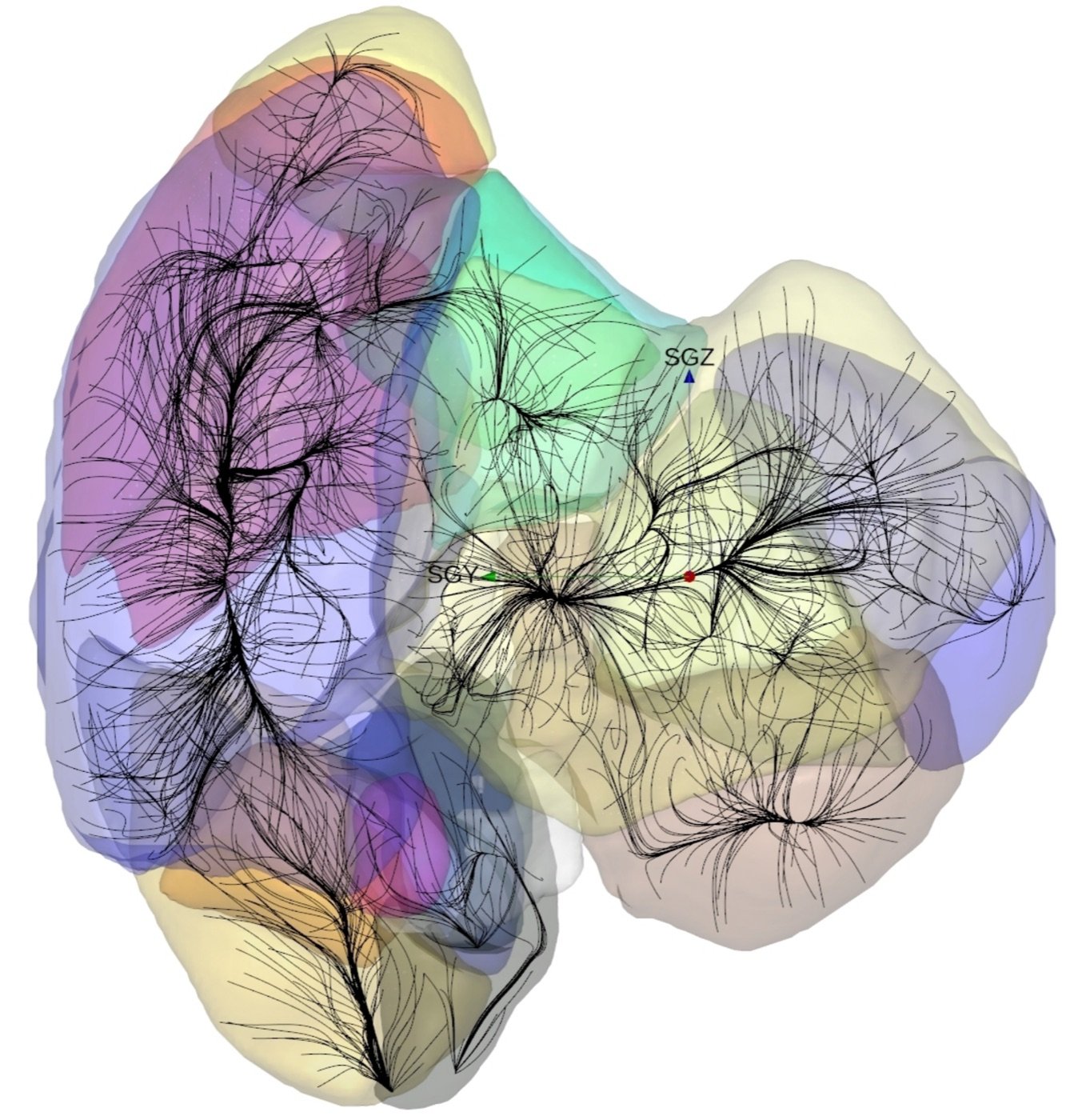
Galaxies have two velocities mixed in their redshift: Hubble expansion, plus a peculiar kick from gravity. If you can measure distances independently, you can subtract the expansion and watch the leftover flow. Streamlines of that flow run downhill in the gravitational potential — away from voids, toward density peaks — and every starting point drains to a sink. The volume that drains to one sink is a basin of attraction (BoA).
Mean density inside a BoA is the cosmic mean. Filling factor is one: every patch of space belongs to some basin. Distant galaxies in the same basin are still flying apart with the expansion. So “we live in a structure 10× larger” does not mean a gravitationally bound super-object that will collapse. It means a larger drainage area on the velocity map.
The 60 / 40 coin flip
The team (HAMLET: Hamiltonian Monte Carlo reconstruction) ran the Cosmicflows-4 catalog — about 56,000 galaxy distances, grouped into 38,000 constraints — through a ΛCDM prior, out to redshifts corresponding to ~30,000 km/s. Distance errors are ugly (~20%), so they do not draw one map and call it truth. They draw an ensemble of equally likely maps and ask how often a given volume drains to a given sink.
- The old Laniakea basin — now tied to a sink near the dust-hidden Ophiuchus cluster — appears in 62% of realizations.
- The Milky Way sits inside that Laniakea/Ophiuchus basin only ~40% of the time.
- Streamlines from the Milky Way terminate in the Shapley concentration ~48% of the time tightly, ~58–60% if nearby scattered sinks are counted.
That is the “60% we live in Shapley” line in the University of Hawaiʻi release. It is a slight probabilistic preference, not a discovery of a new wall. Shapley’s reconstructed volume is 7.02 × 10⁶ (h−1 Mpc)3 versus 0.80 × 10⁶ for Ophiuchus/Laniakea — about an order of magnitude, which is where the “potentially 10 times its volume” claim comes from.
Shapley is not even the biggest thing in the sample
If you only remember Laniakea from 2014, the map has two more bosses:
- Shapley — the previously “largest” nearby basin, at cz ≈ 15,000 km/s.
- Sloan Great Wall — recovered as the largest p-BoA in CF4, volume 15.51 × 10⁶ (h−1 Mpc)3, more than twice Shapley, and it appears in 99% of realizations.
They also recover Perseus–Pisces, Hercules, the South Pole Wall, and a handful of others. Fifteen basins have existence probability > 50%; seven exceed 75%.
Does this “challenge current models of cosmology”?
The tweet says yes. The paper is more careful, and in one important sense it says the opposite: the reconstruction assumes the ΛCDM standard model as the Bayesian prior. Peculiar-velocity data are too noisy to invert without one.
What is uncomfortable is the last line of the results. Shapley, Hercules, the Sloan Great Wall, and the South Pole Wall all run into the edge of the catalog. Uncertainties grow linearly with distance. The outer bounds of the dominant basins are not yet in the data.
“It follows that from the point of view of the BoAs that cosmology has not yet reached its ‘end of greatness’.”
That is the real claim: we have not found a scale at which the watersheds stop getting larger. Homogeneity is still the large-scale assumption of the model. The map just is not deep enough to show you the last ridge.
A reply under the tweet listed brains, mycelium, lightning, river deltas, and neural nets. The resemblance is real as a branching-flow pattern. It is not evidence that the universe is a brain. Gravity plus expansion plus initial fluctuations already make filaments. The interesting number is not the metaphor. It is that 40% of equally likely reconstructions still put us in Laniakea, and the biggest basins still leak off the page.
What to keep
- The red dot is the Local Group. The web around it is Laniakea’s flow field, popularized in 2014.
- A basin of attraction is a drainage basin of peculiar velocities. It is not a bound supercluster.
- With Cosmicflows-4, there is a ~60% preference that our home basin is the larger Shapley watershed, ~10× Laniakea in volume.
- The Sloan Great Wall basin in the same reconstruction is larger still.
- The data stop before the outer walls do. That is the challenge, not a replacement cosmology.
If you want to fly through it rather than stare at a still: Pomarède’s 13-minute video and interactive 3D model are the paper’s actual figures, animated.