An account circulated of an experiment in which ex-vivo human neural tissue was connected to a robotic hand and used in a piano-note task. This note does not currently link or identify the preprint, so the experimental details below remain unverified.
Even if the account is accurate, it would concern local activity in maintained tissue, not the "revival" of a brain. Without the paper, methods, sample description, and results cannot be checked here.
1. The closed-loop setup
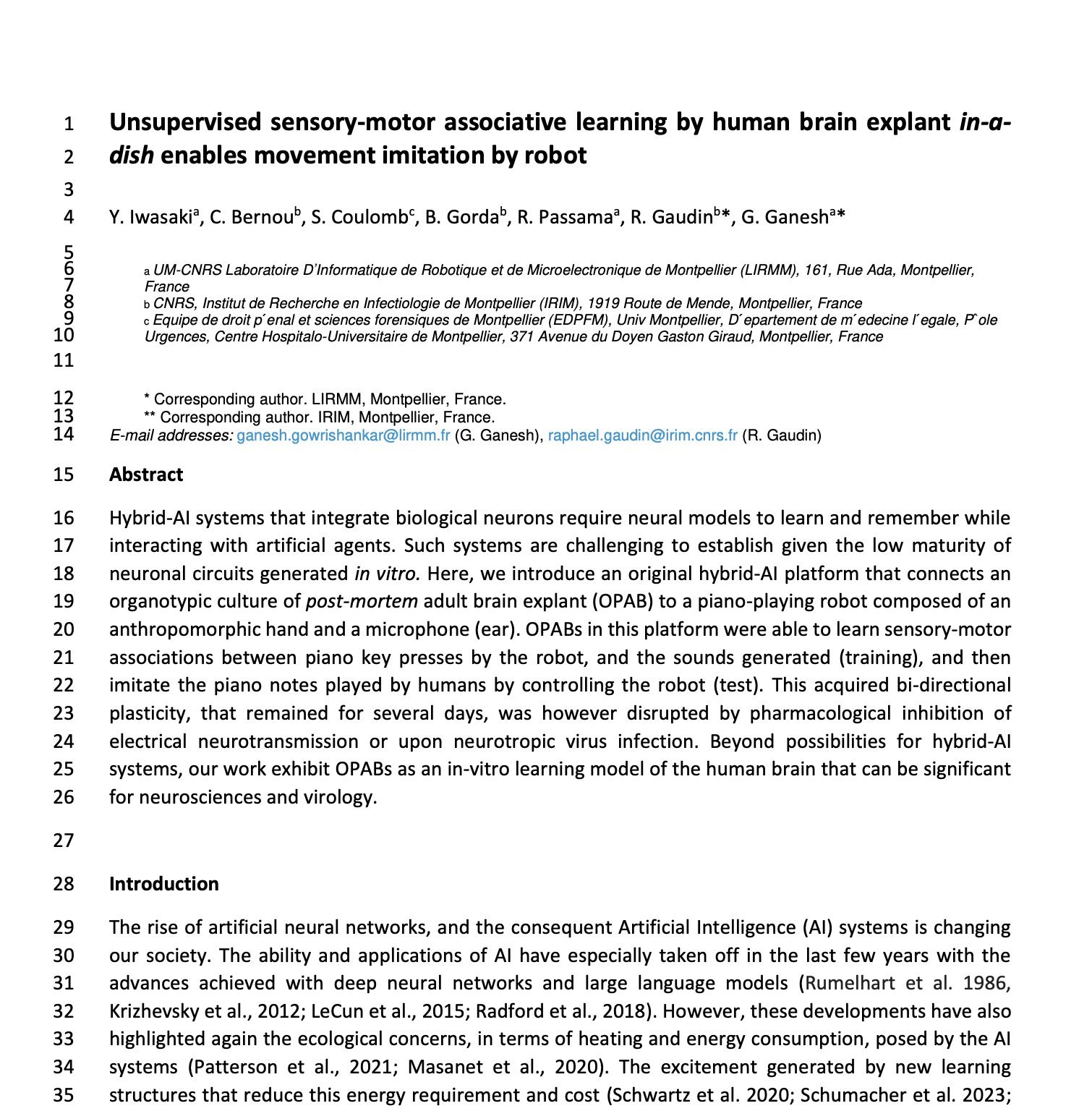
The circulated account describes maintained human cortical tissue connected to a feedback system. The following is a summary of that reported setup, not an independently established result:
- Sensory Input: Microphones and audio sensors capture acoustic note frequencies.
- Neural Transduction: High-density microelectrode arrays (MEAs) deliver spatial-temporal electrical stimulation patterns corresponding to the heard audio.
- Actuation & Motor Output: Spontaneous and stimulated field potentials from the brain slice are decoded to drive a robotic manipulator positioned over piano keys.
2. Reported conditioning claim
The account says that mechanical keystrokes, auditory input, and localized micro-stimulation were paired during training.
Because the paper is not identified in the links attached to this note, I cannot verify the reported accuracy, duration, number of samples, controls, or retention period. Those precise figures have therefore been omitted.
The narrow claim is that the tissue's measured activity changed during a closed-loop task. Establishing conditioning or retained plasticity would require the missing methods, controls, statistical analysis, and source.
3. What the experiment does not show
Local activity in a tissue slice is different from whole-brain function:
- No evidence of consciousness or personhood: The ex-vivo slices are localized neural tissue used for a sensory-motor association task. The reported experiment provides no evidence of higher-order cognition, subjective awareness, or whole-brain coherence.
- No verified plasticity result in this note: A change in task performance could have several explanations. The unidentified report is not enough to establish conditioning, retained plasticity, Hebbian learning, or long-term potentiation.
4. Questions for wetware computing
Biological neurons and silicon accelerators operate under very different conditions, so the reported setup does not support a direct energy-efficiency or computing comparison. At most, the account describes one possible way to place living tissue inside a measurable sensorimotor loop.
Three questions follow from the setup:
- Role of feedback: A controlled comparison would be needed to determine whether feedback contributed to any measured change.
- Interface performance: Any practical claim would require measurements of reliability, lifetime, energy use, and scaling from an identified experiment.
- Viability and function: The source would need to document tissue provenance, viability criteria, preparation, observation period, and controls before any conclusion could be drawn.