Consider what it means to write a program. For most of the history of computing, which is to say about eighty years, a blink in any larger timescale you care to name, it meant one thing. A person holds an intention in their head and translates it, line by laborious line, into instructions a machine can follow. The translation was the work. Entire careers and entire industries were built on the difficulty of it, and we got very good at it, the way you get good at anything you have no choice but to do. And then, in roughly three years, without anyone in particular deciding, the translation became cheap. A machine will now hold your intention, ask two clarifying questions, and produce the instructions itself.
Here is the first extraordinary thing about that. It did not make the work less valuable. It moved the value. When a thing costs almost nothing to produce, everything around it becomes precious. When ten thousand lines of working code can be generated before lunch, the scarce questions are no longer the ones about production. They are the questions before and after: what deserves to be built at all, and once built, how does anyone know it is right. The bottleneck moved, upstream into judgment and downstream into verification, and the typing in between turned out to be the part we could hand over. The cost of a line of code fell toward the cost of a line of prose, and everyone who writes prose for a living can tell you what that means: the value was never in the typing.
The same shape appears, larger and more beautiful, in an unexpected place: a computer game in a web browser. A solo developer has built a fighter jet you can fly from a real runway, up through clouds rendered one ray-step at a time, with clouds built as three-dimensional density rather than painted backdrops, a flight model tracking all six ways an aircraft can move, and radio controllers who talk you home. Then they published fifteen short notes about how it was made, and the notes are the remarkable part. Every figure in them, the footer states, is drawn from the game’s own code and numbers. Where the game departs from physics, the note says so plainly: the cloud shadows switched off on the runway are, in the author’s words, an artistic choice, not physics. Where a fact is uncertain, every line of the reference material carries a trust tier: official, a reputable source, weak, meaning a forum or a model kit, or the author’s own estimate. The controller voices are text-to-speech, disclosed, slowed by 7 percent so they sit calmer in the mix. The model of what nine gravities does to your vision ships with a section called “Where it is gamified,” listing every way it spares you.
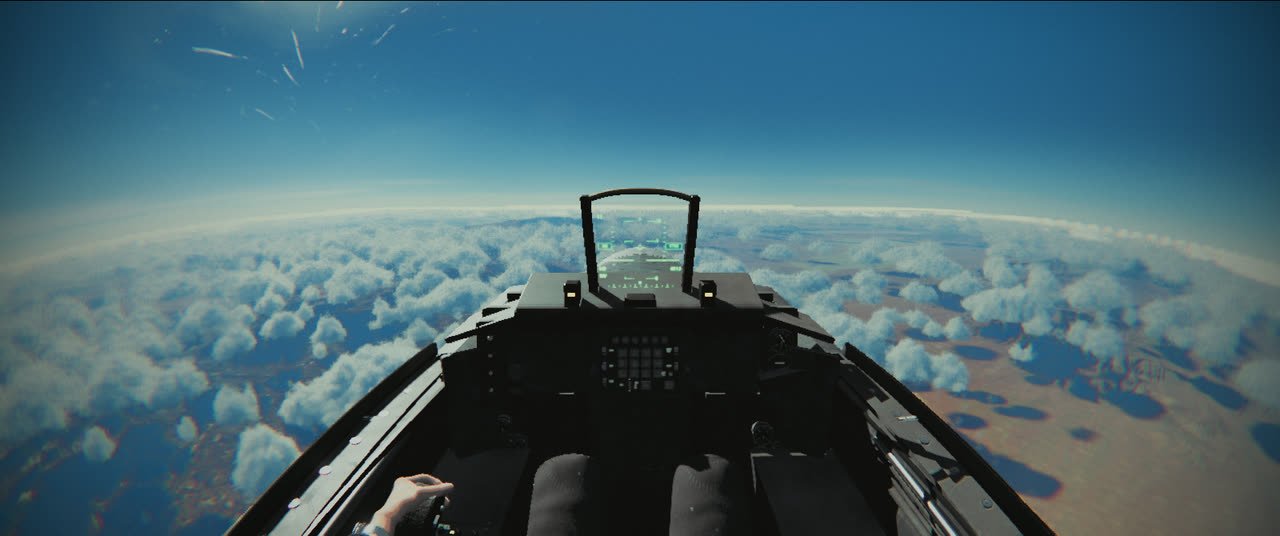
My favorite is the tenth note. Fly above a cloud deck with the sun at your back and the shadow of your own aircraft wears a ring of color, blue on the inside, red on the outside. Pilots photograph this. It is called a glory, and ordinary ray optics cannot produce it at all; you need the full wave treatment of light bending around droplets a few thousandths of a millimeter across. The note does not merely say this. It computes the glory live, in your browser, from the very source file that ships in the game, sampling every ten nanometers across the visible spectrum and viewing the result through the standard response curve of the human eye. One person, one browser tab, and one of the lovelier results in atmospheric optics, rendered from source.
None of that honesty was necessary to ship the game. The code would fly either way. But the honesty is precisely the part that cannot be delegated. A generator does not disclose; it produces. The line between physics and choice, between an official number and a forum rumor, is drawn by a person willing to be held to the difference. And when making is free, that willingness is the whole of what is being sold.
So the work changes shape. The engineer becomes an editor-in-chief of a codebase: compressing intent into constraints a machine can satisfy and a reviewer can check, designing the gates every change must pass, spot-checking where the risk concentrates, and personally owning the parts where feel is the whole point. This is why the product disciplines, the interface, the experience, the argument about what deserves building, move toward the center of the job. They are where deciding lives. But they do not stand alone, and this is the part worth saying plainly. To know that a confident output is wrong, you must know the domain it speaks about. The physics literacy that makes those game notes trustworthy and the arithmetic that catches a confident sentence being wrong by a factor of twenty are the same faculty: depth, worn lightly, available at the moment of review. Judgment without depth produces well-organized nonsense at scale, and scale is exactly what the machines add.
The economics bend the same way. If you account for AI spend by the outputs you actually accept, then the highest-leverage investment is no longer generation, which is the cheap part now, but verification: the tests, the audits, the gates that raise the fraction of machine output you can safely accept. The waste to eliminate is the generation you cannot check. A team that measures hours saved will over-produce and under-verify. A team that measures accepted outputs will buy doubt first and speed second.
And so we arrive at the strange shape of this moment. The machines took the transcription. They took the boilerplate, the recall, the long patient typing, the least human part of the work we ever gave ourselves. It turns out those hours were most of the effort and almost none of the meaning. What remains is what was always the point: deciding what matters, feeling that something is off, saying this is physics and this is my choice, and standing behind the difference in public. The bar did not lower. It moved inward. In the AI era we just have to be even more human, on purpose, in the parts only we can reach. Which, when you consider what we are made of and how briefly, is rather a wonderful invitation.