Lauren Tan's résumé reads like a list of successes: Netflix engineering manager, React Core engineer, React Compiler contributor, then Cursor. The route into that résumé was less tidy. Tan did not start in computer science, and she repeatedly believed she was underqualified for the next job.
She told that story herself in a 2017 essay, I Am Still Learning, and the essay is the backbone of this note. Where the later career is concerned, I rely on her own site and the React team's official record.
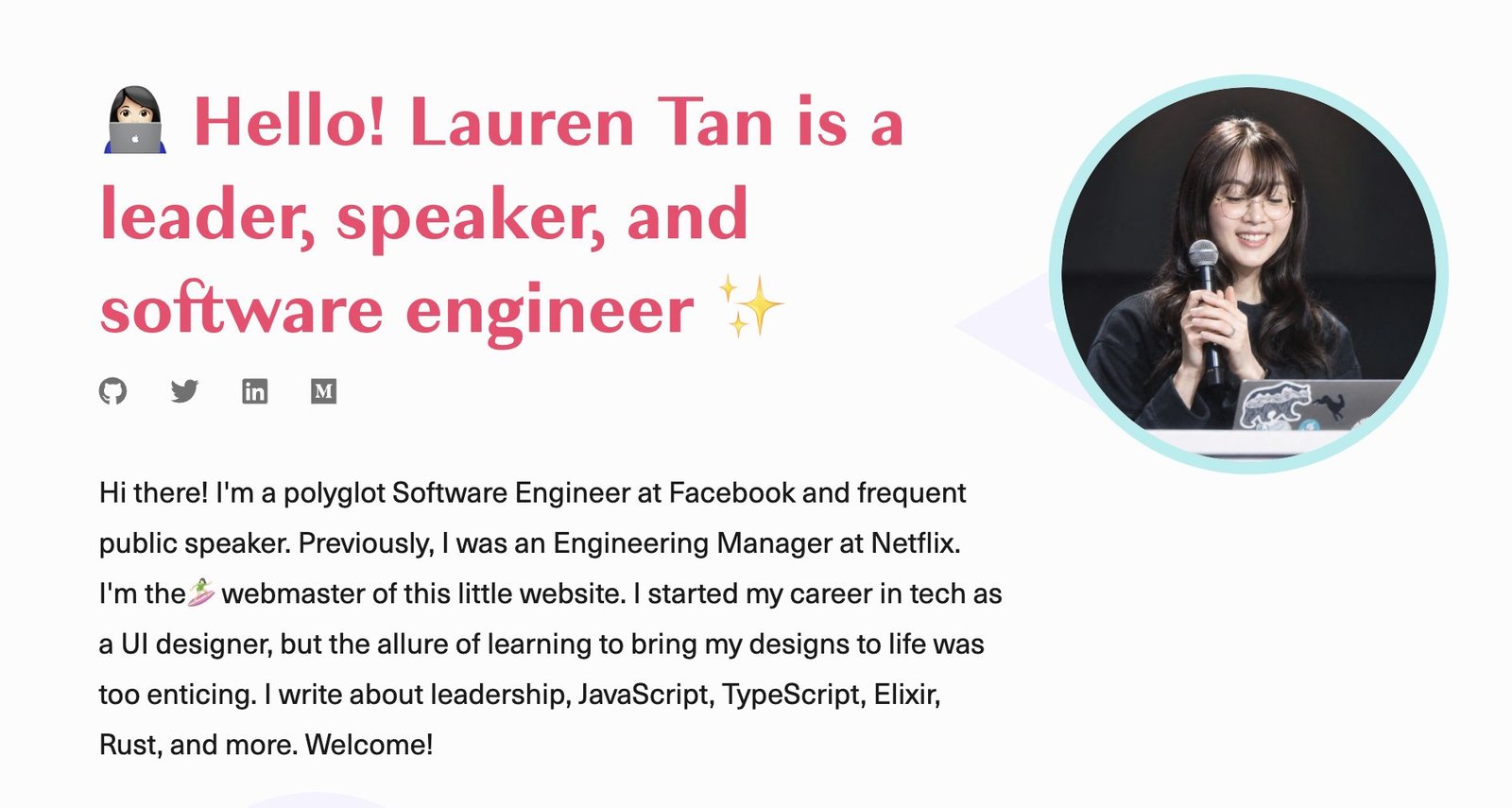
The résumé was not visible from the start
Tan wrote that she spent three years in vocational design school before college in Australia. Her grades had been poor, and she did not think she was smart enough. After college, she and a friend tried to build a startup. Neither could code, so they spent their savings on a developer. The product failed and the money disappeared.
Her first development job began with little more than elaborate Excel spreadsheets, HTML, CSS, and barely enough JavaScript to work as a front-end developer. She learned Ember in public, wrote about it, and accepted an EmberConf invitation despite having little experience and never having attended a conference. Later she chose React for a product, moved to Boston, interviewed at Netflix without a CS background, and accepted an engineering management role even though she preferred programming. By the time she wrote the essay, she led an 11-person Netflix team.
Fear appears before every transition
Tan structures the first half of her essay as a list of admissions. She was afraid to return to school, start a company, begin her first development job, write about Ember, speak at a conference, choose React, interview at Netflix, manage people, and publish the essay itself. One line is especially plain:
I don’t have a CS background. I can’t balance a binary tree to save my life. I was going to fail this interview spectacularly.
She got the Netflix job, but the essay also records the startup failure. Fear appears before both outcomes, so it cannot tell us whether a choice will work. The useful record is what she did next: find a mentor, write down what she learned, or return the following year with another conference talk.
Her conclusion is more demanding than generic advice to be brave:
Surround yourself with stunning people. That’s the only way you’ll learn anything.
We don’t learn alone.
The part that reaches pstack
I connect this older essay to Tan's recent work on coding agents, with a boundary. The 2017 essay says nothing about pstack, evals, or agent orchestration. The continuity is my reading of her method: enter a problem before confidence arrives, find people who know more, make an attempt, inspect the failure, write down what changed, then try again.
Her agent work formalizes parts of that loop. In my earlier pstack note, the useful sequence was to encode a debugging playbook, require the agent to reproduce the problem, verify the fix, and only then add parallel workers. A skill stores the lesson that a model would otherwise forget. An eval makes the next attempt observable. That resembles learning, but the resemblance should not be pushed too far. A person changes through experience; an agent usually needs its environment changed for it.
The later résumé is real
The later career is easy to verify. Tan's own site identifies her as a Facebook software engineer and former Netflix engineering manager. The React team lists her as the author of its October 2024 React Compiler Beta announcement. The announcement describes deployments across Facebook, Instagram, Threads, and Quest Store, and a Meta monorepo with more than 100,000 React components.
That record makes the 2017 essay tempting to read as foreshadowing. I think that is the wrong pressure to put on it. Tan did not know those later outcomes when she wrote, "I am still learning." The sentence mattered because it was true before the success was visible.
Editorial
The fear never left
What stays with me is how little the fear changed. Tan was afraid before college, before the startup, before her first development job, before EmberConf, before Netflix, before a management role she did not want. She got the jobs anyway. The essay is not a story about becoming fearless. She wrote, in 2017, that she was going to keep being afraid. The résumé did not make the fear stop; it just moved it onto the next thing.
The part I find genuinely moving is what she kept in the record. She left in the failed startup and the interview she expected to fail. She started writing in public before she knew much, and kept the early awkward work instead of hiding it. Most career stories edit those parts out. Tan left them in, and that honesty is why the essay still reads well a decade later. It is also the hardest part to imitate. Anyone can claim to be learning. Fewer people publish the part where they are not good yet.