On 27 August, Ashwin Gopinath published an essay called The Instinct Thesis: Why Memory Is Becoming the Moat. It argues that the interesting part of Instinct, the personal AI assistant everyone is posting about, is probably its memory architecture rather than its agent loop. Two days later, Andy Tran replied to the announcement post with two words and a screenshot: "load-bearing".
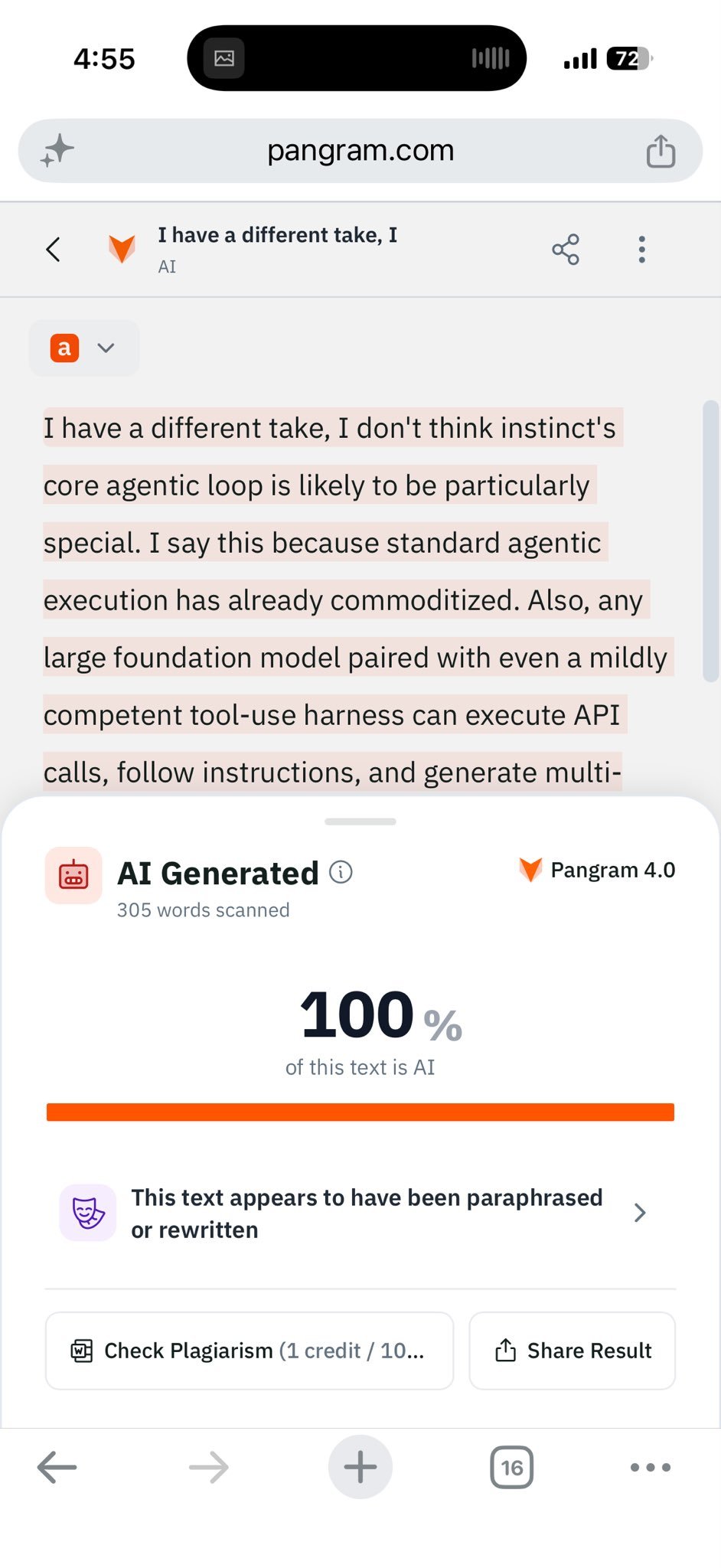
The screenshot shows Pangram, a commercial AI-writing detector, scoring a 305-word passage of the essay. Verdict: 100% AI-generated, with a second line underneath reading "This text appears to have been paraphrased or rewritten".
Why the author's résumé makes this awkward
Gopinath is one of the six authors of Reflexion (Shinn, Cassano, Berman, Gopinath, Narasimhan, Yao, March 2023), the paper that made it standard for a language agent to write its own failure into plain words, keep those words in memory, and do better on the next try. Noah Shinn, the lead author, was Gopinath's student during his time at MIT. Shinn now runs Instinct, officially Spear Street Technology, Inc. Press reports put the company's recent raise at $250M at a $2.5B valuation, and TechCrunch reported last week that early testers are alarmed by its data-licensing terms. So the person speculating about how Instinct works is not a random poster. He co-authored the foundational paper in this exact line of work, and he says so himself in the essay's disclosures.
What the essay claims
The argument, stated fairly. Standard agentic execution has commoditized: any capable foundation model in a competent tool harness can plan, call APIs, and finish tasks. What does not commoditize, Gopinath hypothesizes, is memory. His framing is that the AI cycle is now in its third wave, after foundation-model capability and after tool-use execution: the wave that decides what matters and what should happen next. Instinct feels different from other agents because, he guesses, it carries something like a notebook that it maintains continuously rather than a transcript it rereads.
The essay's central metaphor is that memory is a compiler, not a database. A tape recorder is not a memory, because thinking requires discarding differences and keeping what generalizes. He leans on a computational-neuroscience argument (Richards and Frankland's 2017 Neuron review on forgetting) that memory exists to support future decisions, not to replay the past with high fidelity. From that he derives two utility functions: an admission utility that decides whether an observation is worth storing, and an action utility that decides whether a change in the world justifies interrupting you. When an action is high-value and reversible, the agent acts silently. When it is consequential or irreversible, it asks. When the expected value is low, the correct action is nothing.
He then sketches a four-tier state model: a raw ingestion layer held briefly and discarded, an append-only ledger of admitted events with provenance, a mutable map of beliefs and preferences, and a scratchpad of open commitments. The cable-bill example does real work here: the hard part of an agent cancelling your service is not the phone call, it is holding state across days of waiting and knowing what matters while nothing happens.
His sharpest claim is about proactivity. A good agent is not one that pings you on a timer, because bolting on scheduled check-ins makes the thing feel less proactive, not more. Proactivity has to emerge from a sense of state differentials, the system noticing a change against its notepad and deciding whether that change is worth your attention. His line for this is the one people keep quoting: the deepest evidence of a working utility function is not the well-timed ping, it is the silence.
Each dot is a state change. Reversible and high-value, the agent acts without asking. Irreversible, it interrupts you. Low expected value, it stays quiet. The silence in the third lane is the part the essay calls the real signal.
He is explicit about what he is building on. The essay names Generative Agents, MemGPT and Letta, and Mem0 as prior work on importance reflection and tiered memory, and argues the frontier has moved earlier in the pipeline, from retrieval to admission: deciding what deserves to be stored at all. The same move grounds his privacy claim. If the agent keeps only compressed, useful state and throws away the raw stream, then aggressive forgetting is not a bug but the trust story. His phrasing: the better the notebook, the less of your life anyone needs to keep.
What makes the essay more than a vibe is that Gopinath states falsifiable predictions. If he is right, Instinct should degrade gracefully as history grows, it should handle preference reversals like "actually, I'm vegetarian now" without old facts bleeding through, and it should sometimes deliberately do nothing. His own words: if it pings like a needy app in month three, he is wrong.
What the verdict does and does not establish
Now the reply. Pangram markets itself as the most accurate detector available, citing third-party verification, and 100% is the most confident verdict it can produce. A reading friendly to the screenshot says the passage was drafted or heavily rewritten with a model, which would be consistent with how the essay reads: exhaustive structure, tidy dichotomies, every paragraph shaped the same way. I had the same impression before I saw the screenshot.
A reading friendly to Gopinath starts with the detector literature. The best-known study (Liang et al., Patterns, 2023) found that GPT detectors systematically misclassify polished, structured prose as machine-written, with the burden falling hardest on non-native English writers. Detectors measure texture. They cannot establish who drafted a text, and the second verdict, "appears to have been paraphrased or rewritten", is a stylistic inference, not evidence that a prior human version existed. Even granting that Pangram is the best tool in the category, a 100% score on opinionated prose should read as a strong hint rather than a conviction.
There is also the matter of scale. The essay's announcement post has roughly 340 likes and 127,000 views. The reply has 4 likes and a few hundred views. Most people discussing Instinct this week have no idea this exchange happened.
Gopinath has not responded to it as far as I can find. He could settle the authorship question tomorrow by publishing drafts or process notes. Until then the honest position is: one screenshot, two words, unproven in both directions.
I should disclose my own angle here. I write these notes with agents in the loop, and a detector would probably flag parts of this site. The difference between that and slop is whether the claims get checked against sources and whether a person stands behind them. Detection measures texture, not truth.
Editorial
The thesis survives the accusation
The reason "load-bearing" is a good joke is that it accuses the essay of having an LLM as its load-bearing wall, and the essay's own metaphor makes the accusation land: if the engine is commoditized, then so, arguably, is a lot of the prose about engines. But I keep coming back to the fact that the content does not depend on who typed it.
The memory-as-compiler thesis can be checked against Instinct's behavior over the coming months without asking anyone how the essay was written. If agents with utility-driven memory visibly outlast context-rotted ones, the thesis matters and the authorship question becomes trivia. If Instinct behaves like a needy app in month three, Gopinath said himself he is wrong. That is more falsifiability than most of this week's product discourse manages.
The uncomfortable part is what the exchange says about trust. When authorship cannot be proven by the author and cannot be settled by a tool, attribution stops being a fact you can look up. I would rather the industry land on disclosed assistance than on detectors playing lie detector with total confidence. Neither convention exists yet, and this reply is what the gap looks like in practice: a real argument, a real credential, and a two-word verdict nobody can adjudicate.
One tension is worth naming even though it does not settle the authorship question. The essay's privacy pitch is that aggressive forgetting means less of your life gets hoarded. The report that started the Instinct backlash says the opposite about its actual terms: a license to reuse user data for training. Gopinath is speculating about architecture, not defending the company's contract, and he says outright that he has no inside knowledge. But the gap between the essay's ideal notebook and the product's real terms is where a lot of this week's enthusiasm will either hold or collapse.
Gray dots are raw events. The tape recorder files every one and rots under the weight. The compiler keeps only the gold facts worth betting on, which is the essay's claim about what real memory does.